
Anime Watch Order Guide: Release, Chronology, and Routes
A practical decision map for release order, chronology, alternate routes, recap versions, OVAs, and source-audited franchise guides.
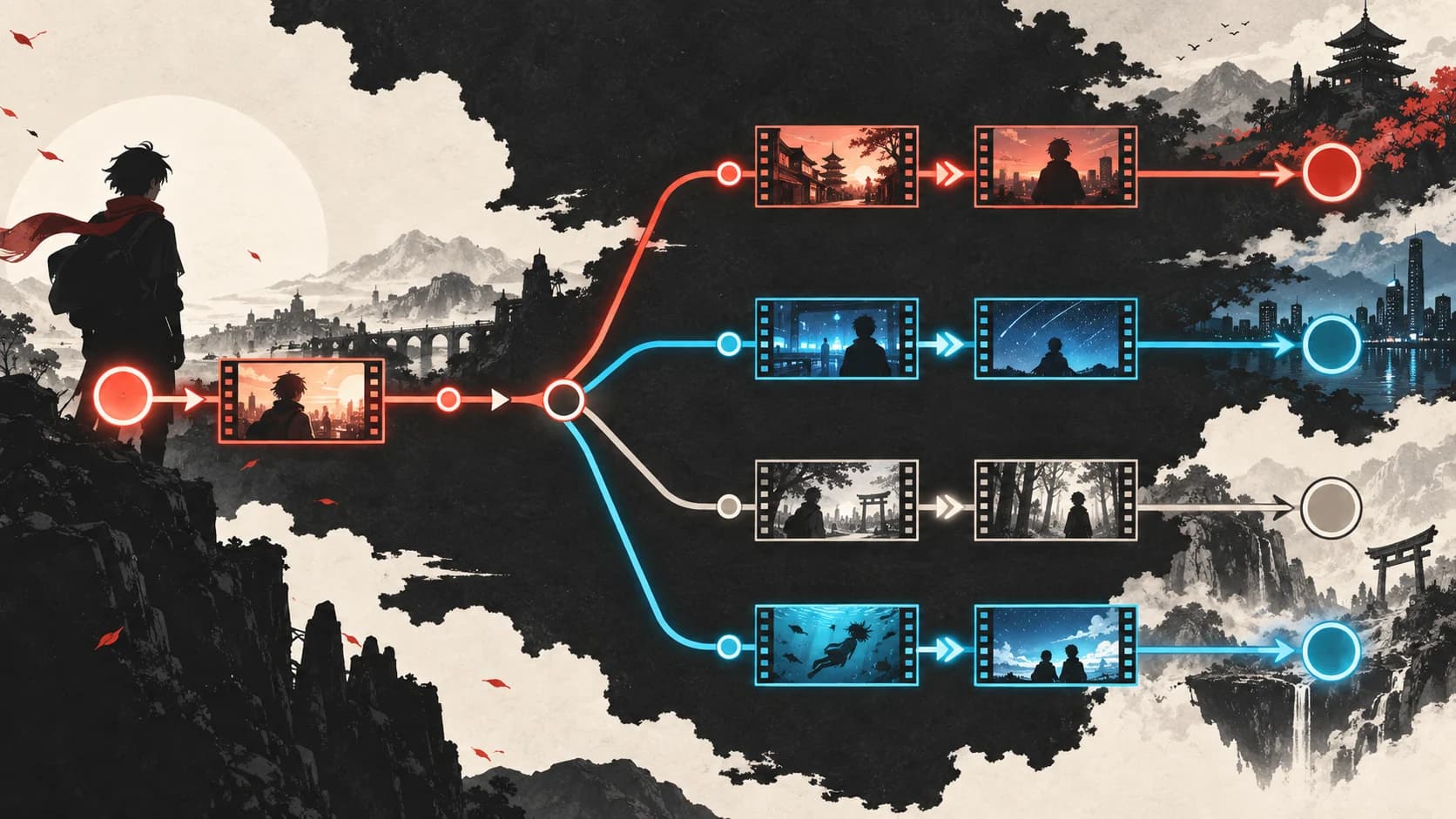
For a first watch, use release order unless the franchise clearly contains alternate adaptations, branching story routes, recap versions, or a prequel that changes when major information is revealed. “Chronological order” is not automatically better: it can expose answers before the work that originally framed the mystery.
Use this decision sequence:
- Identify whether the entries share one continuity.
- Put released main-story entries in release order.
- Choose between duplicate adaptations or recap versions instead of watching both by accident.
- Place optional films, OVAs, and side stories after the entry whose characters or events they assume.
- Keep announced but unreleased projects off the watchable list.
- Verify the exact title, season, language, and territory before choosing a streaming service.
This page is the maintained directory and decision system. Each linked franchise guide owns its detailed episode route, current production status, and source trail.
Use the anime research index for reviews, rankings, release records, and ending analyses that sit outside the watch-order directory.
Pick the right kind of anime watch order
| Franchise structure | First-time default | Change the order when | Main risk |
|---|---|---|---|
| Linear seasons and sequels | Release order | An official listing identifies a recap or duplicate cut | Rewatching the same material under a different title |
| Prequel released after the main work | Release order | You knowingly accept earlier revelations for chronological context | Turning a later reveal into background information |
| Alternate routes | Pick one route sequence, then compare the others | The franchise itself presents mutually exclusive story branches | Treating alternate outcomes as consecutive seasons |
| Remake or readaptation | Choose one adaptation first | You want a deliberate comparison on a rewatch | Combining incompatible continuities |
| Recap film and television cut | Choose one version | The film contains documented new material you want | Counting a condensed retelling as a sequel |
| OVA or side story | After its prerequisite main entry | The official release explicitly places it elsewhere | Meeting characters before their introduction |
| Announced production | Do not add it to the watchable sequence yet | A release and format are actually confirmed | Publishing dates, episode counts, or placement that do not exist |
The labels matter. A work can be a prequel by story chronology while still belonging later in the recommended first-watch order. A film can be optional without being “non-canon.” A recap can contain small new scenes without becoming the next chapter. The order should describe the relationship rather than force every title into one timeline.
Source-audited watch-order directory
These are the franchise routes PrimeTimeAnime has checked against current official production, publisher, or distributor records. The compact answer below helps you choose the correct detailed guide without duplicating its full list here.
| Franchise | Start here | Key decision | Detailed route |
|---|---|---|---|
| Fate/stay night | Unlimited Blade Works is the clearest anime-first entry | Decide whether to add the 2006 Fate-route adaptation first or use Fate/Zero as a spoiler-heavier chronological start | Fate watch order |
| Naruto and Boruto | Naruto, then Naruto Shippuden, then Boruto: Naruto Next Generations | Place The Last late in Shippuden and keep undated projects off the watchable list | Naruto watch order |
| Re:Zero | Season 1 or its Director's Cut, then Season 2 | Insert Memory Snow and The Frozen Bond deliberately; do not watch both Season 1 cuts as separate seasons | Re:Zero watch order |
| Bleach | Original episodes 1–366, then Thousand-Year Blood War | Skip only verified pure filler and retain mixed episodes | Bleach filler and route guide |
| One Piece | Follow the numbered television series | Treat movies and tie-ins as optional branches; keep pure filler separate from mixed and anime-canon episodes | One Piece filler route |
| Evangelion | Television episodes 1–26 before comparing endings | Treat The End of Evangelion as an alternative ending and Rebuild as a separate four-film story | Evangelion version guide |
This narrower directory is intentional. It links only to routes with a current evidence card and leaves older franchise pages out until their facts are rechecked. That prevents one stale “ultimate” table from publishing unsupported episode totals, availability claims, and unreleased sequels across a dozen unrelated franchises.
Fate: choose a route, not one universal timeline
Fate/stay night adapts alternate visual-novel routes. The official project material orders them as Fate, Unlimited Blade Works, and Heaven's Feel; that relationship is different from three seasons following one outcome.
The maintained Fate watch order uses this anime-first route:
- Fate/stay night: Unlimited Blade Works, Episode 0 through Episode 25.
- Heaven's Feel I. presage flower.
- Heaven's Feel II. lost butterfly.
- Heaven's Feel III. spring song.
- Fate/Zero, episodes 1–25.
The official Unlimited Blade Works story index lists Episode 0 through Episode 25. The official Heaven's Feel introduction describes it as the third route and a three-film adaptation. Starting with Zero remains a valid chronological preference, but its prequel knowledge changes how stay night reveals the Fourth Holy Grail War.
Naruto: separate released episodes from future projects
The required television spine is Naruto → Naruto Shippuden → Boruto: Naruto Next Generations. Current distributor records list 220 original episodes, 500 Shippuden episodes, and 293 episodes in Boruto Part One.
The Naruto watch-order guide owns the film placement and optional-route decisions. The official Naruto site confirms that Boruto Part One ended at episode 293 and that Part Two entered production, but its retrieved announcement does not provide a release date. That means Part Two belongs in a status note, not in a watchable sequence with an invented year or episode count.
If your goal is a source-story-first Shippuden run, use the separate Naruto Shippuden canon guide. It keeps manga canon, mixed, anime canon, and filler classifications distinct instead of reducing the series to one disputed percentage.
For the original 220-episode series, use the Naruto filler list as a separate episode-selection layer after choosing the franchise order.
Re:Zero: choose one Season 1 cut
Re:Zero's first decision is format. Watch the original Season 1 episodes or the 13-episode Director's Cut; do not count them as two consecutive seasons.
The complete Re:Zero watch order places Memory Snow after Director's Cut episode 6, places The Frozen Bond after Season 1 and before Season 2, and then continues through Seasons 2, 3, and 4. The current distributor guide and official production records support those insertion points and the active Season 4 structure.
This is a common pattern: a special can fit inside a season chronologically while remaining easier to understand after the season establishes its cast and rules. The detailed route explains both the shortest essential path and the fuller OVA path.
Bleach: keep the original run and TYBW separate
The official Bleach: Thousand-Year Blood War site identifies the first television series as a 366-episode run and TYBW as its concluding arc. The basic order is therefore original Bleach episodes 1–366 → Thousand-Year Blood War.
The difficult part is episode selection inside the original run. The source-checked Bleach filler list identifies 163 pure-filler episodes across 14 ranges and retains 41 mixed episodes. It also corrects a dangerous old shortcut: almost all of episodes 343–366 are manga canon or mixed, so viewers should not discard that closing block.
Do not transfer those labels to TYBW. The official TYBW story page establishes a separate concluding adaptation; it does not provide a filler classification.
One Piece: main-series order is simple, optional material is not
The numbered One Piece television series supplies the main path. The complexity comes from movies, specials, recap material, tie-ins, and community filler labels—not from rearranging the main episodes into a different chronology.
The One Piece filler guide currently identifies 94 pure-filler episodes across 25 ranges under one disclosed classification source. It keeps 43 mixed episodes and 21 anime-canon episodes outside the automatic-skip list. Use those distinctions when shortening the route; an arc summary that calls a whole block filler can erase source-based scenes.
For any movie, decide whether you want optional character or promotional context, then place it after the episodes its cast and abilities assume. The filler guide marks film-adjacent television ranges without presenting the movies as required manga continuity.
Evangelion: compare versions after the television ending
Start with the 26 television episodes. The official Evangelion record confirms that count, while GKIDS describes The End of Evangelion as an alternative ending that remakes the final two television episodes. That supports watching the series first and the film second without claiming that both endings are proven to occur shot-for-shot at the same time.
The Evangelion ending and version guide keeps the television finale, The End of Evangelion, and the four-film Rebuild story separate. It also records the newly announced production as “in production” until the official announcement supplies a format, continuity, plot, or release date.
How to place movies, OVAs, and specials
Ask four questions before adding an optional entry:
- Does it continue the same continuity? If not, label it as an alternate version or branch.
- What does it assume you already know? Place it after the latest required character, ability, or event.
- Does it retell existing material? Choose the television or recap version unless a deliberate comparison is your goal.
- Has it actually released? An announcement belongs in a status ledger, not between two watchable entries.
When an official source does not define placement, the recommendation is editorial. A trustworthy guide should say why it chose that position and what changes if you move the entry.
Release order versus chronological order
Release order preserves the sequence in which the audience originally received information. It is the safest default for mysteries, late prequels, and stories built around hidden identities or past events.
Chronological order is most useful on a rewatch or when the franchise explicitly labels a prequel as the intended entry point. Its tradeoff is straightforward: earlier story time can mean later production context. You may understand the timeline sooner while losing the reveal structure.
Route order applies when works present alternate outcomes, as in Fate/stay night. Adaptation order applies when a remake starts the same source again. Neither problem is solved by sorting every title by fictional calendar date.
Keep streaming availability outside the order
A correct sequence does not prove that one service carries every entry. Catalogs, language tracks, season labels, and rights vary by territory. Use the legal anime viewing guide to verify the exact title and installment after choosing your order.
The anime genres guide can help when labels such as shonen, isekai, OVA, or cour are causing confusion. Demographics, story genres, formats, and source types describe different things and should not be used as continuity labels.
Frequently Asked Questions
What is the best order to watch anime?
For a first watch, use release order within one continuity. Change the sequence only when the franchise has alternate routes, remakes, recap versions, optional side stories, or a prequel whose placement involves a clear spoiler tradeoff.
Should I watch anime chronologically?
Chronological order is usually better for a rewatch. On a first watch, it can reveal information before the work that originally presented it as a mystery.
Do anime movies go between seasons?
Only when their continuity and prerequisites support that placement. Some movies continue the main story, some recap television material, and others are optional branches. Check the exact film rather than applying one rule to every franchise.
Should I watch recap movies?
Choose either the television version or the recap when both cover the same material. Watch both only when you want a comparison or the film documents meaningful new scenes.
Where do OVAs go in anime watch order?
Place an OVA after the latest main entry whose characters and events it assumes. If no official placement exists, treat the recommendation as editorial and explain the prerequisite.
Should an announced anime be included in a watch order?
Keep it in a separate status note until it has a confirmed format and release. An in-production project is not yet a watchable step.
How do I avoid anime filler?
Use a series-specific classification that separates pure filler from mixed and anime-canon episodes. The source-audited filler hub exposes the classification source and date for each maintained series.

Written by WeebRai
Founder · Editor · Chief OtakuOne fan, 12+ years deep, 1,200+ series in. Every review, recap and ranking on PrimeTime Anime is written by WeebRai — checked against the actual episodes and manga, never recycled from press releases.
Share this article
Keep Reading
Test your fandom
Which Naruto Clan Do You Belong In?
Discover your Naruto clan by answering these personality questions.
Take the quiz →
Hunter x Hunter Nen Mastery Examination
Test your knowledge of Hunter x Hunter with these trivia questions about key characters and concepts.
Take the quiz →
Attack on Titan Ultimate Trivia Challenge
Test your knowledge with these hard trivia questions from Attack on Titan.
Take the quiz →