
Evangelion Ending Explained: TV Finale vs End of Evangelion
The Neon Genesis Evangelion TV ending and The End of Evangelion answer the same central problem in different ways: can Shinji accept a self that is separate from other people, even when separation makes pain possible? Episodes 25 and 26 stage that problem almost entirely inside the characters' minds. The film supplies an alternative, external climax: NERV falls, Instrumentality begins, humanity loses its individual form, and Shinji ultimately chooses a world where separate people can exist again.
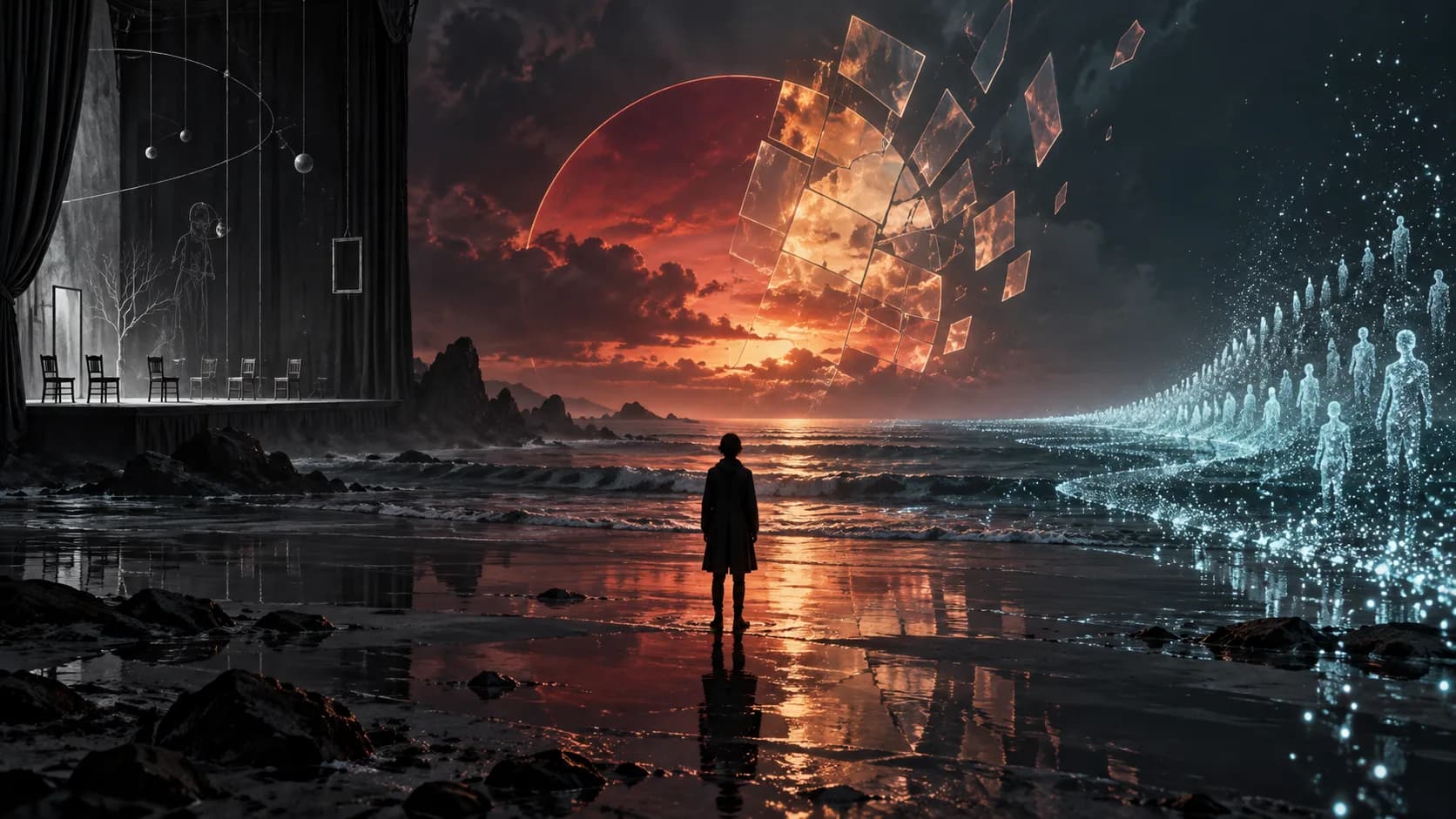
The safest way to understand the ending is to keep three things apart: what the screen directly shows, what a character says, and what viewers infer from the imagery. The TV finale ends with Shinji accepting that he may be able to like himself. The film ends on a beach with Shinji and Asuka, where the return of individual life is real but emotional recovery remains unresolved.
Full spoilers follow for Neon Genesis Evangelion, The End of Evangelion, and the Rebuild films.
Evangelion endings at a glance
Scroll horizontally to see all columns
| Ending | What it directly shows | What it resolves | What remains open |
|---|---|---|---|
| TV Episodes 25–26 | Instrumentality as interrogations, alternate realities, sketches, an empty stage, and a final congratulations scene | Shinji recognizes that his self-image is not fixed and accepts the possibility of living as himself | The external fate of NERV, the Evas, and the physical world is mostly unstated |
| The End of Evangelion | SEELE attacks NERV, Asuka fights the Mass Production Evas, Rei rejects Gendo, Instrumentality dissolves individual boundaries, and Shinji and Asuka return | Shinji rejects a painless existence without separate selves; return becomes possible | How many people return, what society becomes, and what the final beach exchange means |
| Rebuild of Evangelion | A separate four-film story ending with Thrice Upon a Time | Its own versions of Shinji, the pilots, and a world beyond Evangelion | It does not replace the original TV and film endings with one literal explanation |
| New Evangelion series | An official 2026 production announcement with named staff and studios | Nothing about the original ending yet | Story, continuity, format, and release date were not supplied in the announcement |
The official Evangelion site records the original television run as 26 episodes. North American distributor GKIDS describes The End of Evangelion as an alternative ending that remakes the final two television episodes. That wording is more reliable than the common claim that both endings are proven to occur simultaneously.
What happens in the TV ending?
Episodes 25 and 26 abandon ordinary chronology because Instrumentality has removed the familiar boundaries between minds. Shinji, Asuka, Misato, and Rei confront versions of themselves shaped by fear, memory, desire, and other people's judgments. The episode is less interested in showing machinery than in asking what remains when a person can no longer hide behind a stable social role.
Shinji learns that his self-image can change
Shinji begins from a painful assumption: he has value only when another person needs him, especially as an Eva pilot. Inside Instrumentality, that belief is challenged from several directions. The people around him point out that the Shinji he knows is one perspective among many. Other people carry different images of him, and none is the single complete object called “Shinji.”
This does not magically cure his loneliness. It gives him a smaller, more credible realization: the world he experiences depends partly on how he interprets himself and others. If that interpretation can change, his life is not locked into the shape his fear gives it.
The alternate school scene is a demonstration
The comedy-like school sequence shows a world in which the same faces occupy different relationships. Rei is a new student, Asuka is a familiar classmate, and Shinji's parents are present in an ordinary home. The scene is not presented as a secret replacement timeline. It demonstrates that reality and identity can be imagined from more than one frame.
That possibility loosens Shinji's belief that he can exist only as the rejected child and useful pilot. The sequence matters because it turns an abstract statement into an experienced alternative.
Why everyone says “Congratulations”
At the end, Shinji says that he may be able to like himself and that it may be acceptable for him to be here. The stage breaks away into open space, and the cast congratulates him. The applause celebrates that internal shift.
It does not establish that every external conflict has been repaired. Gendo has not become a healthy father, NERV's political crisis is not narrated away, and the physical mechanics of Third Impact are not mapped. The TV finale resolves its chosen question at the level of self-perception.
Calling this scene either a perfectly happy ending or a meaningless hallucination goes beyond what it does. It is hopeful because Shinji accepts possibility. It is limited because possibility is not the same as a restored world.
What happens in The End of Evangelion?
The film begins from the collapsing external situation left near the end of the series. SEELE sends military forces against NERV and later deploys the Mass Production Evangelions. The official Netflix synopsis identifies SEELE's attack and the conflict over who will control Third Impact and Instrumentality.
Asuka returns to battle and is defeated
Asuka regains the will to fight after recognizing her mother's presence within Eva Unit Two. She defeats the conventional attackers and initially overwhelms the Mass Production units. The units revive, mutilate Eva Unit Two, and leave Shinji to encounter the aftermath.
This section gives Asuka a real recovery of agency without pretending that recovery guarantees victory. Her renewed will matters even though the fight ends catastrophically.
Rei rejects Gendo and joins Lilith
Gendo tries to use Rei, the Adam embryo in his hand, and Lilith to control Instrumentality for his reunion with Yui. Rei refuses him. She takes Adam into herself, returns to Lilith, and places the decisive choice around Shinji instead.
This is why “Rei simply follows Gendo's plan” is inaccurate. Gendo assembles the means for his version of the event, but Rei denies him control at the critical moment.
Individual boundaries collapse
As Anti-AT Fields spread, human bodies lose their stable form and become LCL. Souls and memories enter a shared state without the boundaries that ordinarily keep one person separate from another. Instrumentality therefore answers loneliness by removing the condition that makes relationships possible: distinct selves.
The film uses the AT Field as more than a combat shield. Characters describe it as a boundary of the heart, connecting the science-fiction mechanism to the fear of rejection that has shaped Shinji throughout the series. If no boundary exists, nobody can abandon him—but there is also no independent person left to choose him.
Shinji rejects the shared, painless state
Within Instrumentality, Shinji first reaches for a reality without rejection. He then recognizes the cost. A world where minds cannot be separate cannot provide the encounters he actually wants. Misunderstanding and pain return with individuality, but so do affection, choice, and the chance to meet again.
Shinji's decision does not force everyone into a body at once. The film presents return as possible for people who can recover an image of themselves and the will to exist separately. Yui frames that possibility as open wherever life and the human will remain.
The giant Lilith form breaks apart, the red sea remains, and Shinji reaches a shore. The event has ended, but the film refuses a clean societal epilogue.
Why Shinji strangles Asuka on the beach
Shinji and Asuka are the two people shown back in individual form. Shinji begins strangling her. Asuka touches his face, he stops, and he cries. She then delivers the final line, commonly translated as “How disgusting” or “I feel sick,” depending on the release.
The actions are canon. A single official explanation of their entire meaning is not supplied on screen. Several readings fit the sequence, but they should stay labeled as readings.
Scroll horizontally to see all columns
| Beach detail | Direct event | Supported interpretation | Limit |
|---|---|---|---|
| Shinji strangles Asuka | He attacks the first other person shown beside him | He tests whether this separate world can hurt, resist, or respond to him; he also repeats his destructive response to rejection | The film does not give him a spoken motive |
| Asuka touches his face | She responds with a gentle gesture rather than immediate violence | Recognition or compassion interrupts the attack | The gesture does not erase their history or make the scene romantic |
| Shinji stops and cries | Contact changes his action | He receives proof of another will and confronts what he has done | Crying alone does not establish lasting recovery |
| Asuka's final line | She expresses revulsion or sickness | It preserves her separate judgment and refuses a comforting reconciliation | Translation and tone affect nuance, but neither produces a tidy ending |
The beach scene is therefore neither proof that Shinji learned nothing nor a conventional hopeful reunion. It demonstrates the exact bargain he chose: another person can comfort him, judge him, resist him, and remain unknowable. Individual life has returned together with its danger.
Are the TV ending and film the same event?
The two endings share concerns, imagery, and the language of Instrumentality. This makes a complementary reading useful: the TV episodes can illuminate the inner questions that the film places inside a wider catastrophe.
That reading should not be converted into a production fact. GKIDS explicitly calls the film an alternative ending and says it remakes the final two episodes. The official home-video record also preserves the TV finale and the theatrical episodes as distinct versions. Nothing requires viewers to force every line and image into one synchronized timeline.
A practical conclusion is:
- Use the TV finale to understand Shinji's changing self-concept.
- Use The End of Evangelion to follow the external attack, Third Impact, Instrumentality, rejection, and return.
- Compare them thematically without claiming that every shot occurs at the same instant.
The “they are exactly simultaneous” claim sounds definitive but closes a question the official release structure keeps open.
What the major symbols do—and do not—prove
AT Fields make emotional distance physical
The story directly connects AT Fields with boundaries between selves. Their collapse during Instrumentality makes the metaphor operational: eliminating every defensive wall eliminates both isolation and individuality. This is the ending's clearest symbol because the plot and character problem use the same mechanism.
The empty stage exposes constructed identity
The TV ending repeatedly reduces the world to spotlights, chairs, captions, sketches, and voice. These spaces let the characters try identities without the ordinary scenery that makes a role feel permanent. The form supports the episode's argument that perspective helps construct the experienced self.
The official sources used here do not establish that financial trouble forced this choice. Production constraints may be part of Evangelion history, but they are not needed to explain what the finished episode communicates.
Religious imagery is visual language, not a solved code
Crosses, angels, Adam, Lilith, and other borrowed names create an apocalyptic and unfamiliar visual system. The film does not supply a one-to-one theological key that makes Instrumentality a Christian, Buddhist, Kabbalistic, Freudian, or Jungian doctrine.
Those traditions can support comparative criticism. They should not be presented as a secret canon glossary or as proof that the ending endorses one religion or psychological school.
LCL represents shared origin and lost distinction
LCL becomes the visible medium of humanity's undifferentiated state. It works as both plot substance and image: separate bodies return to a common field. Avoid expanding the initials into a confident technical phrase; the ending does not need an invented full name to make the function clear.
For broader terminology, the anime genres guide separates mecha and psychological themes from demographic labels. The Attack on Titan ending explanation uses the same event-versus-interpretation boundary for another disputed finale.
How the Rebuild ending relates
The Rebuild films tell a separate version of Evangelion rather than adding a simple fifth act to The End of Evangelion. GKIDS identifies Thrice Upon a Time as the fourth and final Rebuild installment. Its Shinji reaches a different resolution through a different chain of events and relationships.
Repeated imagery and dialogue invite viewers to compare the continuities. They do not prove that the Rebuild movies are merely another pass through a mechanically fixed cycle. “Loop” remains a useful interpretation, not a universal answer that erases the differences among the works.
Readers comparing other completed stories can continue with the Jujutsu Kaisen ending guide or the Your Lie in April ending explanation. Current legal-service routes vary by territory, so use the where to watch anime guide rather than treating one catalog as worldwide and permanent.
What the newly announced Evangelion series changes
The new project is real, but it does not yet rewrite this ending. On February 23, 2026, the official Evangelion site announced a completely new series in production. It names Yoko Taro for series composition and script, Kazuya Tsurumaki and Toko Yatabe as directors, Keiichi Okabe for music, and Studio Khara with CloverWorks for production.
The announcement does not state the story, continuity, format, release date, or a relationship to the original finale. Claims that it will explain Instrumentality, continue the beach scene, or retcon Shinji's choice are predictions. This page will add those connections only if the production publishes them.
Final meaning and update policy
The TV ending says Shinji's self-hatred is a perspective that can change; accepting that possibility earns the congratulations scene. The film makes the cost of that choice physical. Shinji gives up a painless shared consciousness so that separate people—and therefore real relationships—can exist. The beach proves that return is possible while refusing to pretend that connection becomes easy.
That is the common answer across both versions: isolation cannot be solved by deleting every boundary. A self can be wounded only because it is separate, but separation is also what allows another person to be genuinely other.
This guide will change when an official release adds facts about the new series or when a distribution route changes. It will not turn a fan theory, religious symbol list, production rumor, or alternate translation into a canon answer. The main blog hub keeps this ending analysis connected to maintained guides rather than isolated speculation.
For more source-led endings and franchise explanations, browse the anime guides archive.
Frequently asked questions
What is the Evangelion ending in simple terms?
Instrumentality removes the boundaries between people. The TV ending focuses on Shinji realizing that his self-image can change. The film shows him choosing separate existence again, even though individuality restores pain and misunderstanding along with love and choice.
Should I watch The End of Evangelion after Episode 26?
Yes. Finish the television series, then watch The End of Evangelion. The film is officially described as an alternative ending that remakes the final two episodes and supplies the external climax the TV version largely leaves unstated.
Did Shinji reject Instrumentality?
In The End of Evangelion, yes. He rejects a merged existence without separate selves and makes individual return possible. The television ending expresses a related internal acceptance without mapping the same physical sequence.
Did everyone permanently die?
Human bodies dissolve during Instrumentality, but the film explicitly leaves return possible. Shinji and Asuka are shown back in individual form. The film does not reveal how many others return or what happens afterward.
Why does Asuka say “How disgusting” at the end?
The line preserves Asuka's separate reaction after Shinji attacks her. It can register revulsion at him, their circumstances, what she experienced during Instrumentality, or several of these at once. The film does not select one complete explanation.
Was the TV ending only caused by a low budget?
That claim is too reductive and is not supported by the official records cited here. Whatever production constraints existed, the completed episodes deliberately use stripped-down form to examine perspective, identity, and self-acceptance.
Does Rebuild establish one literal repeating timeline?
No official source cited here defines it that way. Repetition and memory-like imagery support loop readings, but the Rebuild films stand as a separate four-film story with their own final installment.
Will the new Yoko Taro Evangelion series continue the original ending?
The project is officially in production, but its announcement supplies no plot, continuity relationship, format, or release date. Any claim that it continues the beach scene or explains the original Instrumentality is premature.


Published by WeebRai
Owner and editorWeebRai is the online name of Rai, who owns and runs PrimeTime Anime. He chooses what gets published and fixes errors when readers report them. Many guides here were drafted with AI writing tools from the sources linked on the page; facts come from those sources, not from claims of hands-on testing.