
Where to Buy Anime Merch: Verify Products and Sellers
A source-to-seller anime merchandise guide covering first-party stores, partner shops, imports, proxies, marketplaces, preowned goods and order risk.
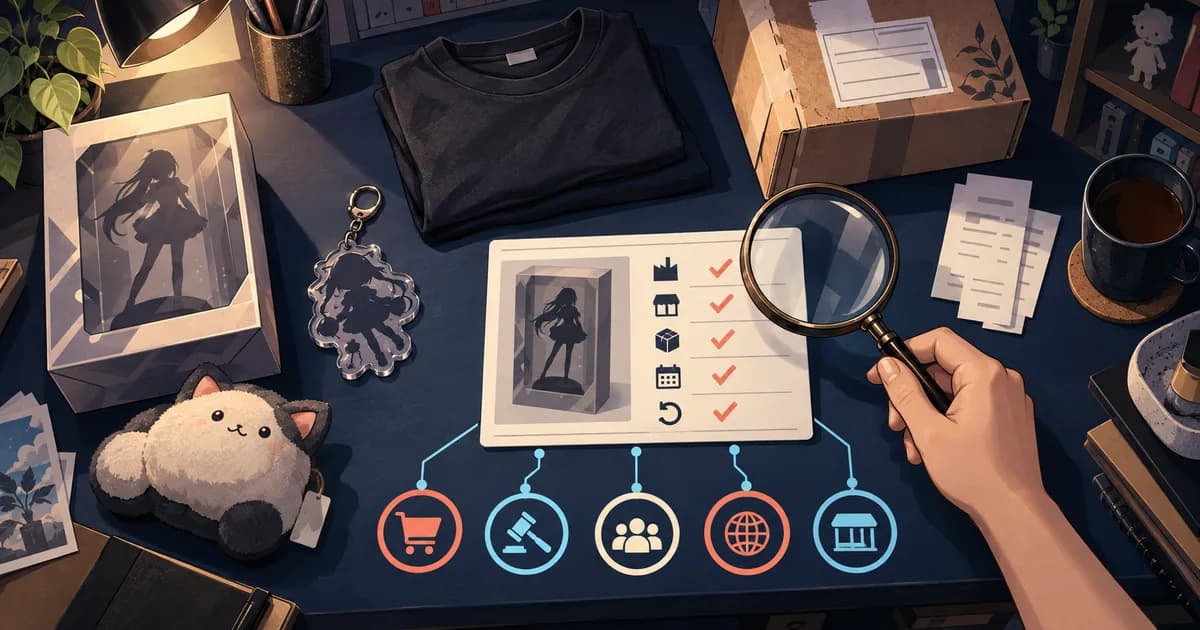
Buy anime merchandise from the route you can verify for that product. A first-party anime store or manufacturer shop gives the shortest evidence chain. A named manufacturer partner can be equally useful. General retailers, import shops, proxies, marketplaces, and preowned sellers can also work, but each adds a different proof or order-risk check.
Do not treat “official” in a page title, a familiar logo, HTTPS, or a license sticker as complete proof. Start with the rights holder or manufacturer, find the exact product record, identify the seller and fulfillment party, then check condition, release state, delivered cost, cancellation, returns, and damage support.
Where to buy anime merch: route comparison
Scroll horizontally to see all columns
| Purchase route | Best starting use | Evidence to require | Order risk to check |
|---|---|---|---|
| First-party anime or rights-holder store | Franchise-specific apparel, accessories, figures, media, or exclusives | Store ownership, exact product page, product category, destination region | Preorder versus in-stock state, sizing, shipping, returns |
| Manufacturer store or partner shop | Figures, model kits, plush, and maker-specific collectibles | Manufacturer product line plus an exact domain match in its partner directory | Product availability, release state, support eligibility |
| General pop-culture retailer | Common apparel, gifts, home goods, and accessories | Product-level licensor or manufacturer details; do not assume every listing has the same status | Seller terms, garment fit, clearance exclusions, returns |
| Specialist import retailer | Japanese releases and collector products with detailed product records | Manufacturer, item code, release state, condition label, destination support | Shipping estimate, preorder commitment, payment timing, cancellation |
| Shopping proxy | A product sold by a Japanese store that does not serve your destination | Original seller and product record, proxy role, warehouse and consolidation terms | Domestic shipping, proxy fees, international shipping, customs, recourse split |
| Marketplace | Broad availability or discontinued listings | Named seller and fulfillment party, exact product match, condition evidence | Seller-specific returns, counterfeit exposure, delivery and dispute path |
| Preowned shop, local store, or event vendor | Sold-out items, condition inspection, local pickup, or convention releases | Product identity, current condition, included parts, seller receipt and contact path | Final-sale terms, missing parts, after-event support, payment protection |
This matrix is a route selector, not a store ranking. Product availability, seller participation, regions, and policies change. Re-run the proof checks for the listing you intend to buy.
Use a source-to-seller proof ladder
The proof ladder has five layers. Stop when a missing layer creates more risk than the purchase is worth.
Product identity
Write down the series, character, item name, manufacturer, product line, item code, format, size, and release state from a first-party record. A retailer title can be shortened, translated, or reused by third-party sellers, so it should not be your only product record.
Bandai Namco Toys and Collectibles America, for example, separates product lines such as Tamashii Nations, Bandai Hobby, Qposket, Banpresto, Gashapon, and MegaHouse. That manufacturer taxonomy helps a buyer distinguish the company and line from the character license or retailer.
Rights holder or manufacturer
Confirm who made or licensed the item. For a figure, model kit, or plush, the manufacturer record is usually the most useful starting point. For apparel, home goods, or media, look for the rights holder, licensed producer, or official franchise shop named on a first-party site.
The TOHO animation Store US identifies itself as the official US store and separates figures, apparel, accessories, home goods, media, preorders, in-stock items, and direct-from-Japan products. That verifies its own route and categories; it does not validate a similarly named seller elsewhere.
Seller and domain
Match the full seller domain, not just a display name. When a manufacturer publishes a partner directory, use it. Good Smile's purchase guidance points buyers to its own store or partner shops and defines those partners as retailers meeting company standards. Its country-by-country partner list lets you compare the retailer domain and region directly.
A partner-directory match supports the relationship for that manufacturer. It does not prove that every product on the retailer site is new, available, correctly listed, or covered by identical support terms.
Listing match and condition
Compare the seller listing with the product record: item name, maker, line, code, dimensions, included parts, release state, and package images. Record whether the item is new, preowned, preorder, backorder, in stock, or supplied by another seller.
A specialist may encode condition in a store-specific way. AmiAmi's current guidance says its preowned products carry a condition rating in the title and an -R signal in the item code. Use that rule only on AmiAmi; another seller may label condition differently.
Payment, delivery, and recourse
Before paying, save the item page and the seller's current terms. Record the complete amount you can see, what remains unknown, when payment becomes due, who can cancel, who receives a damage claim, and what evidence the support process requires.
The FTC's online-shopping guidance recommends comparing manufacturer or model details, size, color, shipping, and total cost; checking return postage, return windows, and restocking fees; and keeping order, payment, policy, shipping-promise, and communication records. It also warns that HTTPS encrypts a connection but does not establish that the seller is legitimate.
Match the proof to the merchandise category
“Anime merch” combines products with very different failure modes. Use the category row before choosing a store.
Scroll horizontally to see all columns
| Category | First record to find | Listing checks that matter most | Continue with |
|---|---|---|---|
| Figures and model kits | Manufacturer product page and product line | Maker, item code, scale or format, included parts, preorder state, partner seller, support | Anime figure collecting workflow |
| Apparel | Rights holder or licensed producer record | Garment measurements, material, print placement, care, size-specific return terms | Anime gift confidence guide |
| Acrylic goods, pins, plush, and small accessories | Manufacturer or first-party franchise listing | Dimensions, material, item code, blind-box state, included pieces | This guide's proof ladder |
| Posters, lamps, desk mats, and home goods | Licensed producer or official store record | Dimensions, material, mounting method, power requirements, surface and return fit | Anime room decor planner |
| Blu-ray, DVD, and other media | Publisher or licensed distributor record | Format, region, language, disc contents, edition, seller | Product-specific media guide |
| Manga and box sets | Publisher page and ISBN | Language, format, volume coverage, edition, release state | Where to buy manga |
Readers who already know they want a figure can use the manufacturer-verified anime figure comparison. Readers buying several manga volumes should use the box-set coverage checker before comparing sellers. If the purchase changes the physical collection, the manga shelf planner covers dimensions, load, light, and capacity.
Treat counterfeit signals as reasons to investigate
Good Smile's current bootleg guidance reports counterfeits purchased through flea-market apps and stores outside its official retailers. It lists missing copyright text, absent manufacturer or brand logos, unusual Japanese, no packaging, and bulk sales as warning signs.
Those signs are not an authentication formula. Good Smile says not every bootleg has the listed characteristics. It also says a company name can appear on counterfeit packaging and that license stickers can vary or be absent. Treat each signal as a reason to pause and seek stronger first-party evidence.
Use this rejection sequence:
- No manufacturer or rights-holder record for the claimed product: stop and investigate.
- Seller claims partner status but its exact domain is absent from the available manufacturer directory: ask the manufacturer or choose a verifiable route.
- Listing photos, product code, parts, or dimensions conflict with the first-party record: do not assume it is an harmless variation.
- Marketplace page hides the named seller or condition: choose a listing that exposes them.
- Price pressure, countdown language, or a rare-item claim tries to outrun verification: keep the evidence standard unchanged.
Counterfeit risk is only one risk. A genuine item can still be the wrong size, a costly import, an inflexible preorder, or a poor fit for the recipient.
Understand import, proxy, and preorder commitments
An import retailer sells the item. A shopping proxy buys from another seller on your behalf. That difference determines which party controls product information, domestic delivery, warehouse inspection, consolidation, international shipping, cancellation, and post-delivery support.
Draw the order chain before paying:
original seller → proxy or import retailer → warehouse → international carrier → destination
Ask which party handles each failure. A proxy may be able to show that the parcel reached its warehouse while the original seller controls a product dispute. The complete cost may include domestic shipping, service fees, consolidation, international shipping, payment conversion, tax, and customs.
Preorder shipping can also remain unknown. AmiAmi's shipping policy says international shipping is calculated after the order is placed and the items are released or ready; it can estimate in-stock shipping when given the item information, but cannot estimate preorder shipping before size and weight are known.
Cancellation is a separate decision. AmiAmi's cancellation policy states that a request is not guaranteed, released preorders after a payment request and backorders are generally excluded, and misuse can lead to account restrictions. These are AmiAmi's current terms, so never generalize them to every import shop.
Complete the checkout evidence sheet
Capture these fields for the final listing:
- Product: first-party URL, manufacturer, line, item name, item code, dimensions, included parts.
- License route: rights holder, licensed producer, first-party store, or manufacturer partner evidence.
- Seller: full domain, named seller, fulfillment party, original seller when a proxy is involved.
- State: new, preowned, preorder, backorder, in stock, blind item, or final sale.
- Money: item amount, visible shipping, tax, membership, proxy, consolidation, conversion, and disclosed import charges.
- Timing: payment point, release state, dispatch estimate, and the party making the promise.
- Recourse: cancellation, returns, return postage, restocking, defects, transit damage, missing parts, and evidence required.
- Records: saved listing, policy, receipt, confirmation, tracking, photos, and support messages.
If an important field is unknown, label it unknown instead of filling it with a store reputation or star rating. That turns uncertainty into a decision: ask, wait, use a different route, or accept the exposure deliberately.
The following is an optional marketplace search after the proof and order checks. It does not establish licensing, manufacturer, seller identity, condition, product match, availability, or support eligibility.
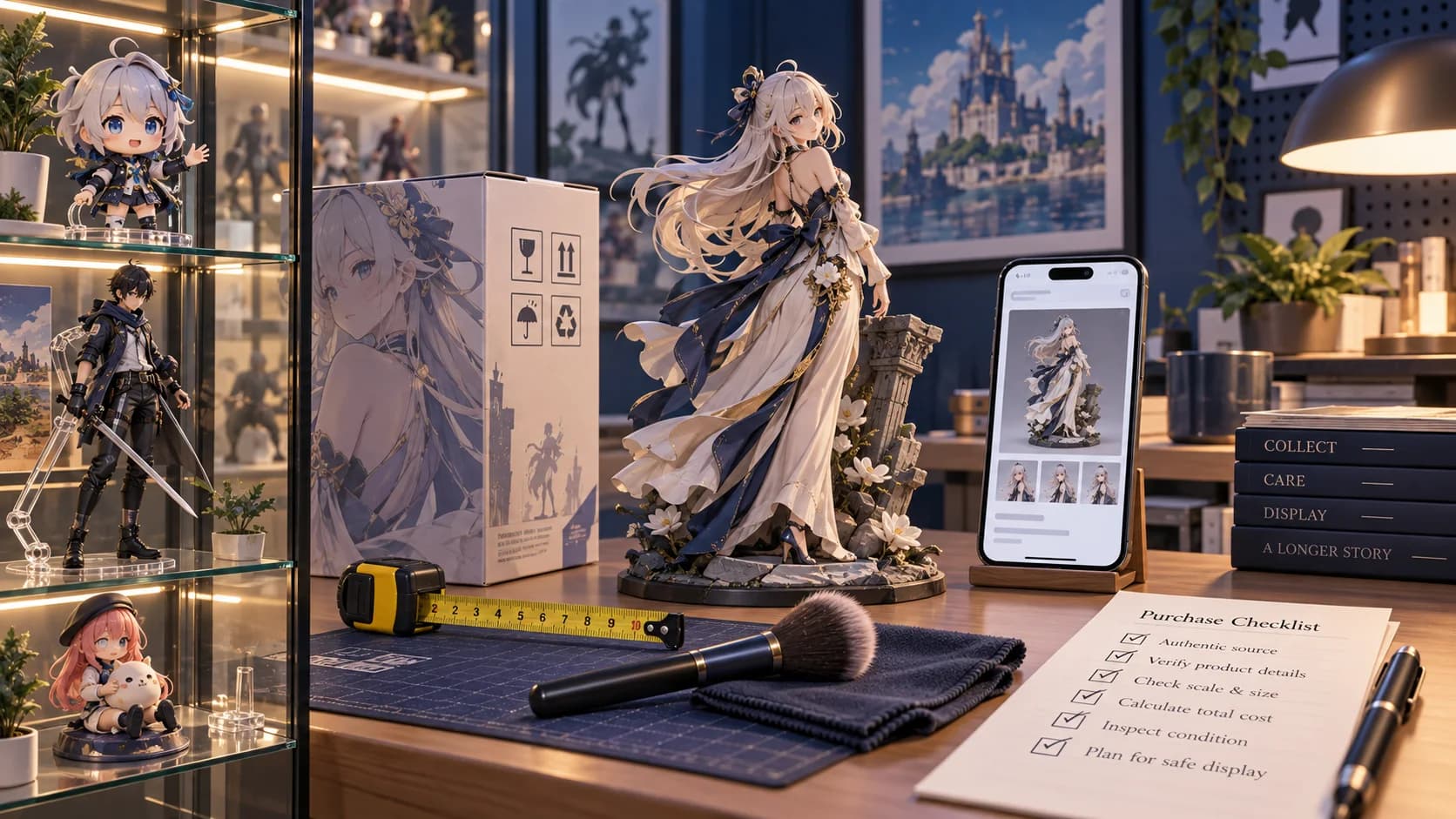
After verifying the exact figure and seller, complete the figure display case measurement checklist before checkout so the base, pose, effects, stand, shelf rating, door opening, anchor point, light, and cleaning method all have a practical home.
For more product verification, collecting, display, and buying workflows, browse the anime merchandise guides.
Frequently asked questions
What is the strongest evidence that an anime product is licensed?
Start with the rights holder or manufacturer's exact product record, then connect it to the seller through a first-party store or manufacturer partner directory when available. Packaging marks and listing text are supporting signals rather than complete proof by themselves.
Is a manufacturer partner shop safe for every order?
A directory match verifies a relationship for that manufacturer. You still need to match the exact product, condition, release state, price components, destination, cancellation, return, and damage terms for the order.
How should I check an anime marketplace listing?
Separate the marketplace, named seller, and fulfillment party. Match the listing to a first-party product record, inspect condition evidence, read the seller-specific terms, preserve the page and receipt, and use a payment method with an appropriate dispute path.
Are Japanese import stores better for anime merchandise?
They solve a different access problem. Use one when its product detail and destination terms fit the item. Account for unknown preorder shipping, payment timing, cancellation, international delivery, condition, and support instead of assuming an import route is automatically superior.
Does a license sticker prove an anime figure is authentic?
No single sticker settles the question. Good Smile states that labels may vary by release and region, may be printed instead of attached, or may be absent. Connect the product record, manufacturer, seller route, listing details, and physical evidence.
Browse the anime merchandise guide hub for category-specific buying, collecting, display, and gift decisions.
Sources Checked
- Good Smile Company bootleg guidance
- Good Smile Company purchase routes
- Good Smile Company partner shops
- Bandai Namco Toys and Collectibles America product lines
- TOHO animation Store US
- AmiAmi shipping policy
- AmiAmi cancellation policy
- AmiAmi preowned-label guidance
- US Federal Trade Commission online-shopping guidance

Written by WeebRai
Founder · Editor · Chief OtakuOne fan, 12+ years deep, 1,200+ series in. Every review, recap and ranking on PrimeTime Anime is written by WeebRai — checked against the actual episodes and manga, never recycled from press releases.