
Figure Display Case: Fit, Load & Safety Guide (2026)
A source-backed figure display case worksheet for checking posed clearance, shelf load, access, anchoring, light, cleaning, and room to grow.
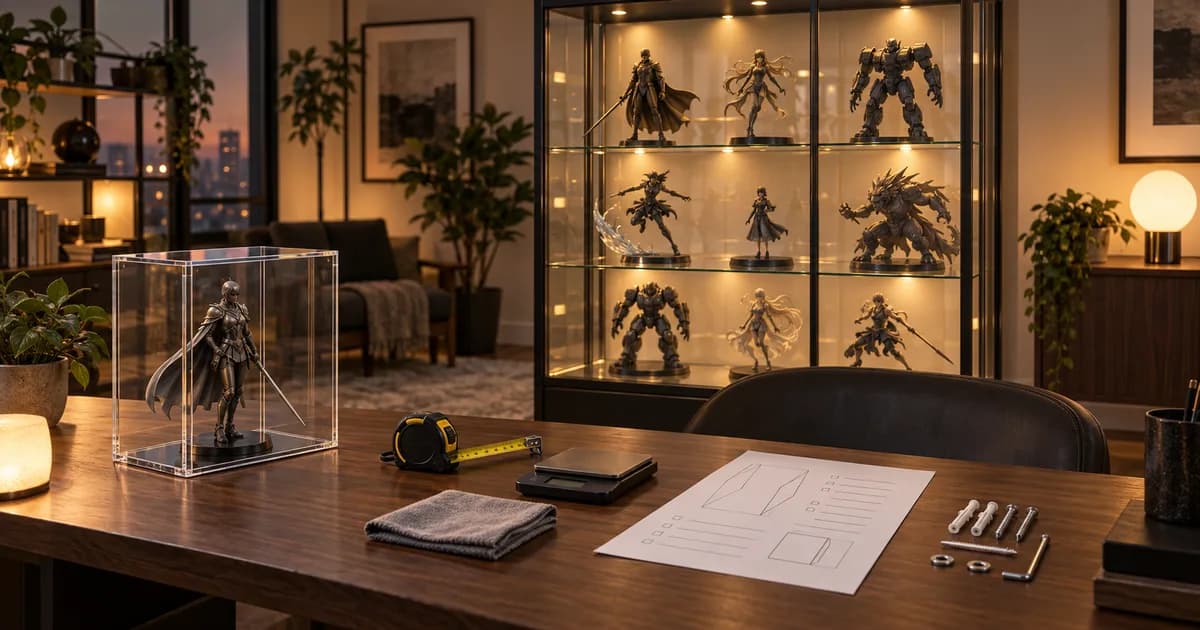
Choose a figure display case by measuring the figure in its final pose, then comparing that envelope with the case's usable interior—not its outside dimensions. Include the base, stand, hair, weapons, effects, risers, lighting, and the hand room needed to place the figure. After fit, verify the shelf-load rating, door access, wall anchoring, light and heat exposure, cleaning material, and space for the next planned piece.
That process is more reliable than copying another collector's cabinet choice. A case can look spacious in a room photo and still fail because a sword crosses the door frame, a shelf rating is too low, or the published measurement describes the outside of the cabinet.
This guide gives you a figure-and-case fit receipt that works on a phone while shopping. It also compares three current glass cabinets using only their published specifications. The examples are reference points, not physical tests or permanent product rankings.
Figure display case quick-fit receipt
Measure first and keep the completed receipt with you. If a product page omits a required value, write unknown. Do not turn an unknown interior measurement or shelf rating into an estimate.
Scroll horizontally to see all columns
| Check | Record for your figure or room | Verify for the case | Reject the case when |
|---|---|---|---|
| Height | Highest point in the final pose, including base and effects | Usable vertical clearance at the intended shelf position | Hair, weapon, effect, or stand touches the shelf above |
| Width | Widest point of the pose, not only the base | Clear span between frame, hinges, and neighboring figures | The pose crosses a frame or prevents safe spacing |
| Depth | Front-to-back envelope of the pose and base | Usable depth with the door fully closed | The figure or base touches the door or back |
| Placement access | Hand room needed to lower, rotate, and remove the piece | Door opening, hinge position, removable shelf, and reach | The figure fits only after risky tilting or force |
| Shelf load | Figure, base, stand, riser, light, and other objects sharing the shelf | Manufacturer's maximum load for that exact shelf | Planned load exceeds the stated rating or no rating can be verified |
| Stability | Floor position, wall type, nearby traffic, children, and pets | Product-specific assembly and wall-anchoring instructions | The unit cannot be installed and anchored as directed |
| Light and heat | Window path, lamps, radiator, vent, and warm electronics | Case location and any internal light placement | Direct sun or a heat source reaches the display |
| Care | Glass or acrylic surface and your cleaning routine | Maker's material and care instructions | The material or cleaning method does not suit the room |
| Growth | Next figure, planned line, or larger centerpiece | Adjustable shelves and remaining usable space | Today's arrangement consumes every practical opening |
The receipt is an elimination tool. It does not produce one universal winner. A compact acrylic cover may be right for one centerpiece; a full cabinet may be more useful for a growing line; an open shelf may remain preferable when access matters more than reduced dust exposure.
For the buying and authenticity decision that comes before display planning, use the anime figure collecting guide. If you are still choosing the next piece, the best anime figures guide separates manufacturers, formats, and buyer fit.
Measure the pose, not the advertised scale
Set the figure up exactly as you intend to display it. Attach the final base, support arm, effect parts, weapons, and optional hair or clothing pieces. Measure the highest, widest, and deepest points from straight-on reference planes. A flexible tape can follow a curve and understate the rectangular space a case needs, so use a rigid ruler, square, or flat objects as boundaries when practical.
The official Good Smile specification for Nendoroid Gon Freecss lists the figure at approximately 100 mm tall and says the included stand should be used because the product does not balance on its own. That height is useful product evidence. It still does not establish the final envelope of the special hair, chosen pose, base, or hand room required to set the figure down.
Measure the base separately. A round base may fit on a shelf while an angled weapon crosses the frame. A narrow figure may have a deep support arm. A figure that clears the closed case may still be hard to move through a smaller door opening.
Add practical room around the measured envelope. The aim is not to invent a universal buffer; it is to prove that you can place and remove the figure without scraping paint, bending a part, or knocking a neighbor. Test that movement with a cardboard outline when the figure is valuable, unusually posed, or close to the candidate limit.
Use interior clearance, not cabinet dimensions
Retail pages often lead with overall width, depth, and height because those values help with room planning. They do not automatically describe the clear space between frames, doors, hinges, shelves, locks, and the back panel.
Keep these measurements separate:
- Overall width, depth, and height decide whether the furniture fits the room, doorway, ceiling, and wall location.
- Usable shelf width is the clear side-to-side span available to the pose.
- Usable shelf depth is the surface available with the door closed.
- Usable shelf height depends on the shelf position and the thickness of the shelf above.
- Door opening can be smaller than the interior, especially around hinges, frames, and overlapping doors.
If only overall dimensions are published, ask the seller or measure the exact assembled model. Do not subtract a guessed frame thickness. Mark the fit unresolved until the clear values are known.
This distinction also protects room usability. A door may open into a walkway, a cabinet may cover an outlet, or the required anchor point may not match the intended wall. The broader anime room decor guide handles furniture placement, lighting, electrical planning, and the rest of the room after the case itself passes this receipt.
Check the complete shelf load
The shelf carries more than the figure. Include the base, stand, riser, other figures, decorative platform, and any light or cable resting on that shelf. Use the manufacturer's rating for the exact model and shelf. Similar-looking cabinets can have very different limits.
Do not translate a rating into a figure count. One large resin-style piece and a row of small articulated figures create different loads and pressure points. A glass shelf also deserves careful handling even when the planned total remains below its rating. Follow the maker's placement and assembly instructions, inspect damage before use, and stop using scratched, chipped, loose, or unstable components.
Distribute objects as the product instructions require. A published maximum is a boundary, not a promise about long-term deflection, poor assembly, an uneven floor, impact, or modifications. If the exact shelf rating is absent, contact the manufacturer or choose a candidate with verifiable specifications.
Three current glass cabinets compared
The table below demonstrates how to normalize official product pages. All dimensions are overall exterior measurements because the cited pages do not provide a separate, complete usable-interior envelope. Confirm the interior and door opening before approving any figure fit.
Scroll horizontally to see all columns
| Published specification | IKEA MILSBO tall | IKEA MILSBO wide | IKEA BLALIDEN |
|---|---|---|---|
| Product record | 003.964.16 | 904.523.04 | 005.205.19 |
| Overall width | 28.75 inches | 39.75 inches | 13.75 inches |
| Overall depth | 16.5 inches | 15 inches | 12.625 inches |
| Overall height | 68.875 inches | 39.375 inches | 59.5 inches |
| Maximum load per shelf | 11 pounds | 44 pounds | 7 pounds |
| Published shelf detail | Three adjustable tempered-glass shelves | Tempered-glass construction; verify current shelf layout on the product page | Three movable tempered-glass shelves |
| Cable detail | Cable outlet; lighting sold separately | Verify the exact product page and instructions | Prepared for cable management |
| Assembly or safety detail | Two-person assembly | Must be anchored with wall-suitable screws and plugs | Must be anchored with wall-suitable screws and plugs |
| Interior clearance | Not separately established by the cited page | Not separately established by the cited page | Not separately established by the cited page |
The wide MILSBO has the highest published per-shelf rating in this comparison and the greatest overall width. The tall MILSBO offers adjustable shelves and a cable outlet, but its listed shelf rating is lower. BLALIDEN uses a narrower room footprint and movable shelves, with the lowest stated shelf rating of the three.
Those differences identify candidates; they do not select one for you. The wide cabinet can still fail a tall pose. The tall cabinet can still fail a wide effect part. The compact cabinet can still be enough for a small group when its measured interior and access work. Run the same receipt on every product, including models outside this comparison.
Prices and inventory are deliberately absent because they change. Before buying, reopen the exact product record and check the current specification, package, delivery, return, assembly, glass-care, and anchoring details.
Choose the case format for the collection
A single-figure acrylic cover uses little room and keeps visual focus on one piece. It works best when the seller provides usable inside measurements and the base gives stable support. Check how the cover lifts: a top-removal design needs free space above and hand room around the figure.
A countertop case can group several small figures without committing to full-height furniture. Measure the internal shelf or platform, door opening, and the surface supporting the entire case. The furniture below must safely carry the complete setup.
A full-height glass cabinet suits a growing collection and offers adjustable presentation across several levels. It adds assembly, wall anchoring, door swing, glass care, and room-footprint decisions. Verify each shelf rating and usable opening rather than dividing the total volume into an assumed figure count.
A low, wide cabinet can support broad poses and keep the upper surface available, but its doors and frame may split the interior sightline. Check whether the widest centerpiece aligns with a frame member and whether reaching the rear requires moving the front row.
A mixed manga-and-figure unit can look cohesive but combines different jobs. Dense books create a load and depth problem; figures create a posed-clearance and access problem. Run the manga bookshelf planner for the book shelves and this receipt for enclosed figure space.
Anchor the furniture and protect the glass
Wall anchoring is a product and room requirement, not a decorative option. The U.S. Consumer Product Safety Commission's Anchor It guidance tells consumers to anchor furniture to the wall to reduce tip-over risk. Follow the exact cabinet instructions and use hardware appropriate for the wall. Seek qualified installation help when the wall, fastener, or location is uncertain.
Place the cabinet on a stable, level surface and complete assembly before loading it. Do not assume heavy objects on a lower shelf replace required anchoring. Keep doors, routes, and controls usable after installation.
IKEA's current wide MILSBO guidance also warns that damaged or scratched glass can break and that side impacts are a particular concern. Inspect panels and shelf edges, keep hard objects from striking the glass, and follow the maker's care and replacement instructions. A higher load rating does not cancel glass-handling rules.
If children, pets, or busy walkways are part of the room, include them in the location decision. The best measured fit can still be the wrong installation point when a door opens into traffic or the cabinet cannot reach an appropriate wall anchor.
Reduce light and heat exposure
A transparent enclosure does not establish a verified ultraviolet rating. Choose the room position first: avoid a path where direct sunlight reaches the figures, and keep the case away from radiators, heating ducts, hot lamps, and electronics that noticeably warm the enclosure.
The Canadian Conservation Institute's plastics guidance explains that light and ultraviolet exposure can discolor, weaken, embrittle, and crack plastic objects. It recommends avoiding sunlight and ultraviolet exposure, using minimum display-light intensity, and avoiding hot lights or nearby heat sources. Commercial figures contain different plastics, pigments, coatings, and mixed materials, so use this as a conservative placement principle rather than a prediction for one product.
When adding internal lighting, confirm the cabinet's cable route and the light maker's installation requirements. Position cables so they do not interfere with the door, shelf seating, anchor, or figure base. Check the enclosure after the light has operated; discontinue a setup that creates noticeable heat or unstable mounting.
Clean glass and acrylic by material
Identify the transparent material before choosing a cleaner. The Canadian Conservation Institute's display-case cleaning note warns that some household cleaners contain abrasives that can scratch acrylic and solvents that can cause fine surface cracking. It also notes that acrylic can develop static during cleaning and use, which attracts dust.
Follow the case maker's current care instructions. Use a clean, soft material and a compatible cleaner rather than assuming a glass product is suitable for acrylic. Spray or apply cleaner in a way that keeps liquid away from figures, shelf joints, lighting, and unfinished surfaces. Remove figures before any cleaning step that could expose them to droplets or impact.
Doors and covers reduce routine room exposure, but seams and opening cycles still require inspection and cleaning. Check the figures and shelves on a schedule that fits the room instead of waiting until dust is visible in fine sculpted details.
Plan the next figure before filling the last gap
Use the final row of the receipt to name the next likely addition. If you collect one line, check its largest announced or owned pose. If the collection mixes scales and formats, reserve one adjustable opening rather than filling every shelf around today's average figure.
Growth space must remain usable. Empty volume behind a front row does not help if the rear figures cannot be seen or reached. Risers can improve sightlines, but they add height and weight and can make placement harder. Re-run the receipt for the complete arrangement after adding one.
If the next purchase comes from a new seller or marketplace, verify the manufacturer, product identity, named seller, condition, delivered cost, and support route with the anime merchandise buying guide. Gift buyers should also check the anime gift guide before assuming another figure or case suits the recipient's room.
Compare current figure display case listings
Only shop after the receipt gives you minimum usable width, depth, height, load, access, and installation requirements. Search results change, so verify the exact model and named seller rather than carrying a specification from one listing to another.
Reject a listing that hides usable interior measurements, shelf-load evidence, material, door access, assembly, or safety information you need. A lower price cannot repair a failed fit or unknown rating.
Browse the anime merchandise and collector hub for the connected figure, room, shelf, gift, and purchasing decisions.
Frequently Asked Questions
How do I measure a figure for a display case?
Assemble the intended pose and measure its highest, widest, and deepest points, including the base, stand, hair, weapons, and effects. Then check the door opening and leave enough hand room to place and remove the figure without contact.
Are exterior cabinet dimensions enough?
No. Exterior dimensions establish room footprint. Figure fit depends on usable interior width, depth, height, shelf position, frame, hinges, and door opening. Treat a case as unresolved when those clear measurements are missing.
How much weight can a glass shelf hold?
Use the manufacturer's rating for the exact model and shelf. Include figures, bases, stands, risers, lights, and every other object sharing the shelf. Do not infer a rating from glass thickness, appearance, or another cabinet.
Does a display case protect figures from sunlight?
Transparency alone does not establish a tested ultraviolet rating. Keep the case outside direct sunlight and away from hot lights and heat sources unless the product provides specific evidence and instructions for a different setup.
Is glass or acrylic easier to clean?
They require different care. Acrylic can scratch or develop fine cracks when exposed to incompatible cleaners and can attract dust through static. Identify the material and follow the maker's current cleaning instructions.
Should a figure cabinet be attached to the wall?
Follow the exact product instructions. The cited IKEA wide MILSBO and BLALIDEN require wall anchoring, and CPSC recommends anchoring furniture to reduce tip-over risk. Use fasteners suitable for the wall and seek qualified help when uncertain.
Sources Checked
- IKEA — MILSBO tall glass-door cabinet — checked September 16, 2026
- IKEA — MILSBO wide glass-door cabinet — checked September 16, 2026
- IKEA — BLALIDEN glass-door cabinet — checked September 16, 2026
- Good Smile Company — Nendoroid Gon Freecss — checked September 16, 2026
- U.S. Consumer Product Safety Commission — Anchor It — checked September 16, 2026
- Canadian Conservation Institute — caring for plastics and rubbers — checked September 16, 2026
- Canadian Conservation Institute — cleaning glass and acrylic display cases — checked September 16, 2026
Recheck the product record and repeat the fit receipt whenever the pose, shelf arrangement, light, room, or planned collection changes.


Written by WeebRai
Founder · Editor · Chief OtakuOne fan, 12+ years deep, 1,200+ series in. Every review, recap and ranking on PrimeTime Anime is written by WeebRai — checked against the actual episodes and manga, never recycled from press releases.