
Strongest One Piece Characters: Evidence-Based Top 10
Kaido ranks first in our current One Piece power ranking, followed by Shanks, Luffy, Blackbeard, Mihawk, Sakazuki, Kuzan, Garp, Borsalino, and Zoro. This is an editorial order based on demonstrated peak performance, opponent quality, repeatability, official titles, and ability breadth. It is not a claim that every matchup has a settled answer.
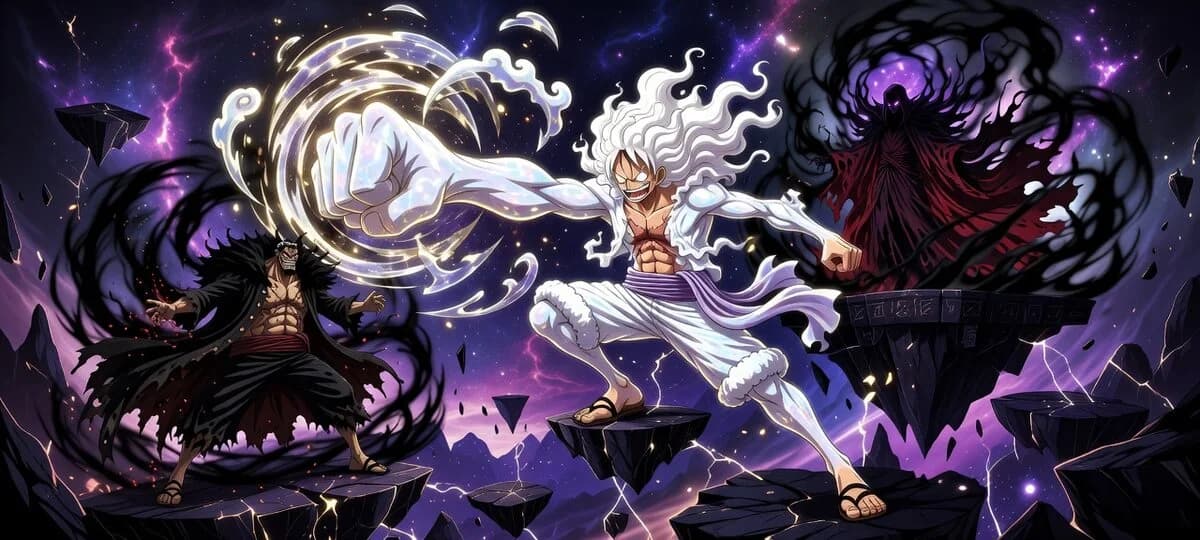
The list uses completed Wano and published Egghead evidence available by September 15, 2026. It excludes predictions about unresolved later arcs. If you want crew roles and character development, use the One Piece character guide; the ranking below compares combat evidence across the wider world.
One Piece power ranking at a glance
Scroll horizontally to see all columns
| Rank | Character | Strongest confirmed benchmark | Main comparison limit | Confidence |
|---|---|---|---|---|
| 1 | Kaido | Endured the alliance battle before Luffy’s final victory | His defeat followed a long sequence of opponents and damage | High |
| 2 | Shanks | Emperor status, elite Haki portrayal, and the ability to stop major conflicts | Too few extended fights for a complete matchup profile | Medium |
| 3 | Monkey D. Luffy | Defeated Kaido with Gear Five and advanced Haki | Stamina and battle context make a clean rematch uncertain | High |
| 4 | Marshall D. Teach | Wields both darkness and quake powers and has defeated elite opponents | Often wins through preparation and favorable situations | High |
| 5 | Dracule Mihawk | Holds the official title of world’s strongest swordsman | Limited recent full-length combat evidence | Medium |
| 6 | Sakazuki | Defeated Kuzan and became Fleet Admiral | Few post-timeskip battles are shown directly | High |
| 7 | Kuzan | Former Admiral with large-scale ice control and elite endurance | His clearest direct comparison ends in defeat to Sakazuki | High |
| 8 | Monkey D. Garp | Legendary Marine whose physical force and Haki remain elite | Age and current condition complicate peak-versus-current comparison | Medium |
| 9 | Borsalino | Admiral-level light powers, speed, and long-range pressure | Egghead shows that mission context and emotion affect performance | High |
| 10 | Roronoa Zoro | Defeated King after learning to release more of Enma’s power | His best confirmed win remains below Emperor-level evidence | High |
The confidence column describes the evidence behind the placement. “Medium” does not mean weak; it means the character’s reputation or title carries more of the comparison than completed, directly comparable fights.
How this One Piece power ranking works
Power scaling becomes unreliable when one signal is treated as a universal score. Bounties include political threat, knowledge, crew influence, and public narrative. Titles matter, but they do not reveal every matchup. A dramatic attack may establish peak output without proving endurance. A victory may depend on allies, terrain, preparation, or the opponent’s earlier damage.
We therefore apply five questions in order:
- What is the strongest completed result? A decisive win or sustained performance carries more weight than a prediction.
- Who was the opponent and what condition were they in? Context prevents a group battle from becoming a false one-on-one claim.
- Can the performance be repeated? A costly temporary form differs from a fighter’s normal operating level.
- Does an official title resolve a specific category? Mihawk’s title is direct evidence about swordsmanship, while “Emperor” describes status as well as individual force.
- How broad is the matchup toolkit? Haki, Devil Fruit interactions, range, speed, durability, and tactical choices can change an otherwise close fight.
This method also explains why we do not rank Imu, Dragon, or the Five Elders here. Their narrative importance is clear, but the released evidence does not yet provide the same kind of completed, comparable combat record. Leaving a character unranked is more accurate than assigning a position from mystery alone.
1. Kaido — the completed endurance benchmark
Kaido remains the best demonstrated all-around combat benchmark. The official Kaido profile confirms his Mythical Zoan dragon ability, while the official Wano summary records the decisive context: the alliance invaded Onigashima, several fighters engaged the Emperors, Luffy was pushed to defeat, Gear Five emerged, and Luffy finally won.
That context supports two conclusions at once. Luffy earned the victory, and Kaido absorbed far more than a fresh one-on-one exchange before the final attack. Kaido combines Haki, enormous physical durability, aerial movement, elemental offense, and multiple combat forms. No other completed arc supplies such a broad stress test against so many capable opponents.
The placement does not predict a rematch. It recognizes the most complete released evidence of sustained peak performance.
2. Shanks — the strongest high-confidence portrayal with limited duration
The official Shanks profile identifies him as an Emperor and records his intervention at Marineford. Shanks repeatedly changes a conflict before it becomes a prolonged fight, which is evidence of authority and threat but creates a ranking problem: short demonstrations reveal overwhelming Haki and timing without showing his full defensive limits.
We place him above Luffy because the story still presents him as a standard Luffy has not surpassed cleanly, and because his brief combat evidence has been decisive. Confidence remains medium because portrayal cannot replace a complete matchup record. Mihawk’s swordsman title also prevents any honest ranking from treating the Shanks–Mihawk question as settled by reputation alone.
3. Monkey D. Luffy — the strongest fully demonstrated active progression
Luffy has the clearest modern growth record. His official profile confirms the Nika fruit identity and advanced Haki, and the Wano summary confirms the result against Kaido. Gear Five changes his body and surroundings while allowing unusually creative responses to pressure.
His greatest strength is adaptation. He learns inside the fight, combines Haki layers with Devil Fruit freedom, and turns an opponent’s apparent advantage into a new attack path. The limit is cost: peak transformations and repeated recoveries make it difficult to treat the final Wano exchange as proof that a fresh Luffy always defeats a fresh Kaido.
4. Marshall D. Teach — the hardest toolkit to model
The official Blackbeard profile confirms that Teach possesses both the Yami Yami no Mi and Gura Gura no Mi. Darkness can disrupt Devil Fruit advantages at close range, while quake power creates destructive pressure across a much larger area.
Teach is difficult to rank because preparation is part of his strength. He selects targets, builds a crew around useful abilities, and accepts damage while pursuing a larger advantage. That makes him dangerous without making every victory a neutral duel. His confirmed toolkit earns a high placement; his tendency to engineer favorable conditions keeps him below the best demonstrated endurance and Haki benchmarks.
5. Dracule Mihawk — a title with a narrow, powerful meaning
The official Mihawk profile calls him the world’s strongest swordsman. That title is direct evidence within swordsmanship and must matter in any ranking containing Shanks or Zoro. It does not automatically answer how every Devil Fruit, Haki specialty, battlefield, or team fight resolves.
Mihawk sits below the Emperors with extensive current combat evidence because his recent full capabilities remain mostly unstated. He sits above Zoro because Zoro’s dream depends on surpassing him and the official title remains intact. This is a medium-confidence placement built on unusually strong category evidence and unusually limited modern fight duration.
6. Sakazuki — the cleanest direct Admiral comparison
The official Sakazuki profile confirms the result most useful to power scaling: he defeated Kuzan and later became Fleet Admiral. Unlike a fan-created “Admiral tier,” this is a direct comparison between two closely matched senior Marines.
Sakazuki’s magma power supplies exceptional offense, but the more important evidence is endurance against an opponent with a competing large-scale Logia ability. He ranks below Mihawk because the story gives Mihawk an unresolved strongest-in-category title; he ranks above Kuzan because their result is settled. The lack of many current on-panel fights limits precision without erasing the direct win.
7. Kuzan — elite scale with one decisive ordering result
The official Kuzan profile identifies him as a former Admiral and confirms his loss to Sakazuki. His ice can control terrain, disable groups, and pressure opponents at range, while his durability keeps him competitive in extended exchanges.
Kuzan’s position illustrates why a loss does not remove someone from the top group. The result establishes Sakazuki above him for this method; it also shows that Kuzan could sustain an extreme fight against the eventual Fleet Admiral. His later choices add tactical uncertainty, but they do not require inventing a new power level.
8. Monkey D. Garp — peak legacy versus present condition
The official Garp profile identifies him as the Hero of the Marines and connects his reputation directly to the Roger era. His combat identity relies on physical force and Haki rather than a Devil Fruit shortcut, which makes his remaining output especially revealing.
The ranking challenge is time. Peak Garp belongs in any discussion of the world’s greatest fighters, while current Garp cannot be assumed identical to that peak. His recent performance supports elite power, but age, protection of allies, and battle condition make exact placement against current Emperors uncertain. Medium confidence is the honest label.
9. Borsalino — speed, range, and mission context
The official Borsalino profile confirms his Admiral position and Pika Pika no Mi light ability. He can apply pressure at range, reposition quickly, and force opponents to solve a speed problem before they can execute their preferred plan.
Egghead adds valuable comparison evidence without producing a simple scoreboard. Luffy can contain and damage him, but stamina, objectives, allies, and Borsalino’s emotional conflict shape the exchanges. That places him below fighters with cleaner decisive results while keeping him above Zoro’s current confirmed opponent level.
10. Roronoa Zoro — the strongest Straw Hat below Luffy
The official Zoro profile defines him as the crew’s combatant and Mihawk’s eventual challenger. Wano gives him his best completed benchmark: contributing against the Emperors and then defeating King after adapting to Enma’s demands.
Zoro’s attack ceiling is high enough to threaten stronger opponents, but landing a damaging attack is not the same as winning a full matchup. He ranks below the Admirals because their demonstrated scale, mobility, and endurance remain broader. He ranks above the other Straw Hats because his role, Haki development, and completed victories form the crew’s strongest combat record after Luffy.
The current Straw Hat combat order starts with Luffy, Zoro, Sanji, and Jinbe. Below that group, matchups become increasingly situational: Franky, Robin, Brook, Chopper, Nami, and Usopp provide different forms of range, control, durability, and support. A forced total order hides those differences, which is why the former crew-only page now resolves to this canonical ranking and the character guide owns non-combat crew analysis.
What bounties and titles can—and cannot—prove
Bounties are useful story evidence because they show how institutions assess threat. They still combine combat danger with knowledge, alliances, leadership, public events, and political risk. Robin’s historical knowledge is the clearest example of why the number cannot become a strength score.
Titles are narrower. “World’s strongest swordsman” directly affects Mihawk’s comparison with swordsmen. “Emperor” describes a pirate’s position in the world, including crew and territory as well as personal strength. “Admiral” establishes an elite institutional role, while Sakazuki’s direct victory provides stronger ordering evidence than the shared rank alone.
Readers comparing other franchises can continue to the strongest anime characters ranking or the specific Naruto versus Luffy analysis. Those pages use their own evidence boundaries rather than copying this order across incompatible power systems.
Sources, spoilers, and update policy
This ranking was checked against official ONE PIECE.com profiles and story summaries on September 15, 2026. The VIZ chapter index is our English publication checkpoint. The ranking uses completed Wano and published Egghead evidence; later unresolved outcomes do not silently change a placement.
An update requires one of three things: a completed fight that changes the direct comparison, an official ability or title correction, or enough repeated evidence to change a medium-confidence placement. A trailer, theory, bounty alone, or single ambiguous panel is insufficient.
Anime viewers can use the One Piece filler list to reach canon arcs efficiently and the legal One Piece streaming guide for current viewing routes. The broader rankings hub collects lists with comparable editorial methods.
If you are watching the power shifts arc by arc, the maintained One Piece dub release tracker shows which episodes are currently available in English and which upcoming dates are calculations.
Frequently Asked Questions
Who is the strongest One Piece character in this ranking?
Kaido ranks first because the completed Wano battle provides the broadest evidence of endurance, offense, Haki, and repeated performance against many capable opponents. Shanks may eventually surpass that position, but his extended comparable combat record remains smaller.
Is Luffy stronger than Kaido now?
Luffy defeated Kaido, and that result is canon. It does not prove that every fresh rematch has the same outcome because Kaido fought through the larger alliance battle before the final exchange. We rank Kaido first and Luffy third while treating the gap as debatable.
Why is Imu missing from the top ten?
The published evidence does not yet provide the same completed, comparable combat record as the ranked fighters. Mystery and narrative authority are not substitutes for demonstrated matchup evidence.
Are bounties power levels in One Piece?
No. Bounties combine combat threat with leadership, knowledge, alliances, public events, and political danger. They can support context but cannot settle a fight by themselves.
Who is the strongest Straw Hat after Luffy?
Zoro holds that position in this method because his role, Haki growth, contribution against the Emperors, and victory over King form the crew’s strongest completed combat record below Luffy.
Published by WeebRai
Owner and editorWeebRai is the online name of Rai, who owns and runs PrimeTime Anime. He chooses what gets published and fixes errors when readers report them. Many guides here were drafted with AI writing tools from the sources linked on the page; facts come from those sources, not from claims of hands-on testing.
Share this article
Test your fandom
One Piece Grand Line Knowledge Test
Test your advanced knowledge of the One Piece world with these challenging trivia questions.
Take the quiz
Which One Piece Straw Hat Pirate Are You?
Find out which Straw Hat Pirate from One Piece you are most like by answering these personality questions.
Take the quiz
Anime Series Trivia Quiz
Test your knowledge of popular anime series and their main characters.
Take the quiz