
Manga Storage Box: Size, Fit & Care Guide (2026)
A source-backed manga storage box worksheet for exact-edition fit, usable interior dimensions, row support, material evidence, safe handling, and retrieval.
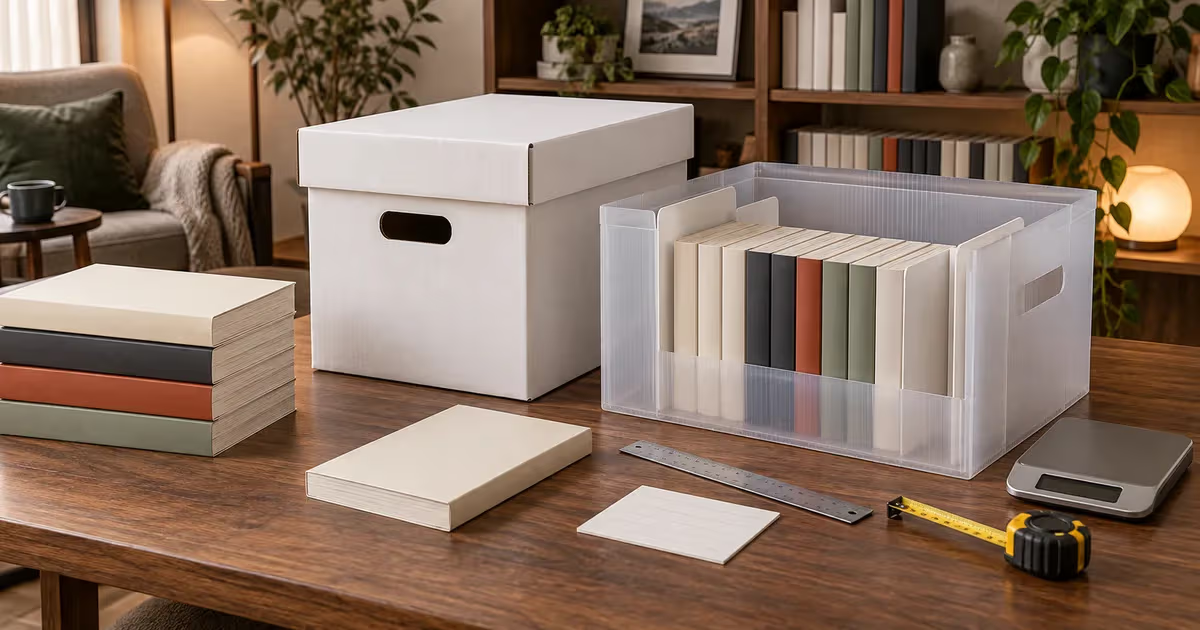
Choose a manga storage box by measuring the exact editions you will store and comparing them with the box's usable interior dimensions. Confirm book orientation, lid and removal room, partial-row support, material evidence, actual filled weight, shelf placement, storage environment, labeling, and retrieval frequency before buying.
A seller's book count is only an estimate. Manga paperbacks, omnibuses, hardcover editions, slipcases, and art books differ in width, height, depth, and spine thickness. A container marketed for manga can still be too short for one edition, too wide to support a partial row, or too heavy to move safely after filling.
This guide gives you a phone-friendly fit receipt, a worked example, and a source-linked comparison of current specialty boxes. It is for rotation, moving, and off-shelf storage. For books that will remain visible and frequently accessible, use the manga bookshelf size and load planner.
Manga storage box quick-fit receipt
Fill in the left side before shopping. Copy specifications only from the exact product record. Write unknown when a required value is missing; do not substitute an exterior measurement or seller photo.
Scroll horizontally to see all columns
| Check | Record from your books and room | Verify from the box | Reject or pause when |
|---|---|---|---|
| Tallest edition | Bottom edge to top edge, including slipcase | Usable interior height in the intended orientation | The lid, flap, or rim touches the book |
| Widest edition | Spine to fore edge | Usable interior width | Covers must bend, bow, or rub to fit |
| Thickest and deepest edition | Spine thickness and front-to-back book depth | Interior row length and removal room | Capacity depends on compressing books or guessing from outside dimensions |
| Orientation | Upright or flat, based on condition and format | Lid clearance, supports, seams, and access | The arrangement leaves books leaning or difficult to remove |
| Partial-row support | Empty length after the planned books | Compatible divider or stable spacer | A partly filled upright row can slump |
| Material evidence | Collection value, condition, and storage duration | Identified board or plastic and any specific acid-free claim | The listing offers only a vague marketing label |
| Filled weight | Actual books, dividers, sleeves, and box | Handle and construction details; supporting shelf limit | You cannot lift, carry, or place it safely |
| Location | Dry room, shelf elevation, light, heat, pipes, and inspection access | Box footprint and lid-opening space | The location is damp, hot, exposed to direct light, or hard to inspect |
| Retrieval | Series grouping and how often books are needed | Label surface, lid access, and stack order | Reaching one book requires moving an unsafe pile |
The receipt can approve a fitted box, rule one out, or reveal missing evidence. It does not promise that a container will preserve every book indefinitely. The room, handling, book condition, and inspection routine remain part of the decision.
If you are still choosing which edition to own, start with the where to buy manga verification guide. It separates publisher, ISBN, edition, seller, condition, delivered cost, and return evidence before storage becomes relevant.
Measure every outlier edition
Group the books that will share a container. Measure the tallest, widest, deepest, and thickest volume in that group. Check slipcases, dust jackets, hardcover corners, unusually wide omnibuses, and volumes with loose or damaged parts separately.
Use the dimensions this way:
- Trim width runs from the spine to the fore edge.
- Book height runs from the bottom edge to the top edge.
- Spine thickness controls how much row length each book consumes.
- Book depth in storage depends on orientation. An upright book's trim width usually occupies the box's front-to-back shelf space; a flat book changes the comparison.
- Removal room is the space needed to grip a volume without pulling its headcap or scraping neighboring covers.
Do not assume all books from one publisher share a format. Reprints, deluxe editions, hardcovers, omnibuses, box-set volumes, and regional editions can differ. Measure the books you own and the exact editions already ordered.
Create a simple cardboard template of the box opening when a product is close to the limit. Pass the largest book through the template in the intended orientation. The exercise checks opening access, while the actual product dimensions still decide interior fit.
Interior and exterior dimensions do different jobs
Exterior dimensions answer room questions: Will the container fit the shelf, closet, doorway, or moving vehicle? Interior dimensions answer book questions: Will the editions fit without bending, and can you remove them?
Keep these fields separate:
Scroll horizontally to see all columns
| Dimension | What it decides | Common mistake |
|---|---|---|
| Exterior width, height, and depth | Shelf footprint, lid clearance, carry path, and room planning | Treating outside size as book space |
| Interior width and height | Edition fit in the chosen orientation | Ignoring the rim, lid, folded board, or tapered wall |
| Interior row length | Combined spine thickness plus divider and removal room | Converting a seller count into a guaranteed capacity |
| Opening size | Whether the largest edition can enter and leave safely | Assuming the opening equals the widest interior point |
When a retailer lists three dimensions without naming their order or stating that they are interior measurements, preserve that limitation. Contact the seller or measure the exact assembled product. Do not silently reorder the numbers to make a book fit.
Worked fit example: one VIZ paperback and one BCW box
VIZ lists its paperback edition of Baron: The Cat Returns at 5 inches wide and 7.5 inches tall. BCW lists its Media Storage Box with an interior width of 6 inches, interior height of 7.75 inches, and interior depth of 18.5 inches.
In the stated upright orientation, the sample book's published width and height are below the box's published interior width and height. That resolves two fit fields for this one edition.
It does not resolve:
- the book's spine thickness or the row length required by a series;
- the effect of sleeves, dividers, or removal room;
- every other volume or edition in the collection;
- the condition of the book or best orientation for a damaged copy;
- the filled container's actual weight;
- the suitability of its material for the reader's storage duration and risk tolerance;
- the shelf, carry path, room conditions, or inspection schedule.
This is the right level of conclusion: two published dimensions pass, and the remaining fields stay open until measured.
Current manga storage boxes compared
The first three products come from the current Bags Unlimited manga storage category. Its category summary publishes three dimensions per product but does not establish that they are usable interior measurements or identify their order for your orientation. The BCW page separately labels its interior and exterior dimensions.
Scroll horizontally to see all columns
| Product | Published material | Published dimensions | Seller count language | What remains unresolved |
|---|---|---|---|---|
| Bags Unlimited XMGNS20 | Plastic corrugated | 7.75 × 5 × 10.625 inches | No count in the retrieved category summary | Dimension order, usable interior, opening, load, and filled handling |
| Bags Unlimited XMGNL20 | Plastic corrugated | 9 × 6.125 × 11.625 inches | Seller estimates 20 larger books | Exact-edition fit, interior status, removal room, and filled handling |
| Bags Unlimited XMGNL30 | Cardboard | 9 × 6.5 × 15 inches | Seller estimates 25–30 larger books | Exact-edition fit, interior status, material specification, and filled handling |
| BCW 1-BX-MEDIA | White corrugated paper | Interior: 6 × 7.75 × 18.5 inches; exterior: 6.75 × 8.5 × 20.5 inches | Seller estimates about 30 DVDs, games, or manga | Exact edition count, filled weight, safe carry limit, shelf support, and long-term material fit |
These rows compare published facts; they do not rank durability or collection care. The Bags Unlimited sizes may suit different formats, but readers must confirm usable interior dimensions and orientation. BCW supplies clear interior and exterior measurements, which makes the first fit screen easier, while its broad item-count estimate still cannot substitute for actual spine measurements.
Prices and inventory are omitted because they change. Reopen the exact page before buying and verify the SKU, material, dimensions, closure, handles, assembly, seller, delivery, and return terms.
Treat capacity language as an estimate
To estimate row fit, add the actual spine thickness of the planned books, divider, and removal space. A practical worksheet looks like this:
Required row length = combined measured spine thickness + divider thickness + chosen removal room
Compare that result with usable interior row length. Do not divide the box length by one average spine and call the answer universal. Check outliers and the actual row because volumes vary.
The Bags Unlimited category associates one larger plastic box with 20 larger books and one cardboard box with 25–30 larger books. BCW describes its media box as holding about 30 DVDs, games, or manga. Those are seller estimates across products with different dimensions and objects. They are useful for screening, then your measurements decide.
If a full row barely fits, removal can damage covers and spines. If the row is loose, books can lean. Choose enough room for controlled access and add stable support rather than compressing the row.
Support a partially filled row
The Canadian Conservation Institute's basic book-care guidance recommends storing books vertically with support, avoiding tight packing, grouping similar sizes when feasible, and keeping stacks to a minimum.
For an upright partial row:
- use a stable divider or spacer that will not collapse into the books;
- keep support broad enough to avoid a pressure point on one cover;
- avoid adhesives or rough edges touching the volumes;
- leave enough room to remove a book without pulling from the top of its spine;
- re-position the divider as the series grows.
A divider also improves retrieval by separating series, languages, editions, or reading states. Label the divider and outer box consistently so a book can be located without opening every container.
Large, fragile, or damaged books may need a different enclosure or flat support. The same CCI guidance says stable enclosures can buffer environmental changes, reduce light exposure, and retain loose binding parts. For rare or damaged material, consult a qualified book conservator rather than treating a general retail box as treatment.
Verify the material claim
The current CCI note on making enclosures for books and paper objects explains that a properly sized enclosure helps protect a book during handling and retain detached pieces. It also warns that the word archival can be used in marketing and is not meaningful on its own.
For paperboard, look for a specific acid-free statement and enough product detail to identify what will touch the books. For plastic, look for the named plastic rather than a generic “plastic” description. Preserve unknowns when the listing does not provide that evidence.
Material is only one part of storage. A fitted enclosure does not correct dampness, direct light, heat, active pests, a leaking pipe, crushing, or unsafe handling. Match the box to the value, condition, duration, and risk of the collection.
If the books arrive from a seller with uncertain condition, document stains, odor, moisture, insects, loose pages, and damage before mixing them into the collection. The manga purchase guide covers seller and condition verification; this page begins after the exact edition is known.
Weigh the filled box and plan its support
BCW describes double-thickness handles and bottom, calls the product stackable, and publishes a 200 lb board test strength. That test-strength statement describes its corrugated board. It does not provide the maximum book weight you may place inside, a safe carrying limit, the required supporting shelf rating, or a safe limit for boxes placed above one another.
Weigh the actual empty box, books, sleeves, dividers, and spacers together. Compare that total with the supporting shelf's current manufacturer rating. If a filled box is awkward, reduce its contents or move books in smaller groups. Plan the route before lifting: doors, stairs, corners, floor obstacles, and the destination surface all matter.
Avoid building a tall pile that makes lower books inaccessible or crushes a container. Keep stacking to a minimum, follow the product's instructions, and place heavy containers where they can be reached without lifting over shoulder level. Do not put a box on the top of a shelving unit where it is difficult to inspect and vulnerable to overhead water.
For permanent open storage, the manga bookshelf guide checks clear shelf dimensions, actual book weight, per-shelf rating, anchoring, light, and humidity. A storage box and a bookcase must each pass their own load and access decisions.
Choose a dry, stable, inspectable location
The container is not the whole environment. CCI advises against storing books in attics, damp basements, near radiators or furnace pipes, near plumbing pipes, or on top of shelving. The Library of Congress book-storage guide likewise emphasizes storage and environment and identifies shades, curtains, and boxes as ways to reduce damaging light exposure.
Choose a location that is:
- dry and reasonably stable rather than subject to large heat or humidity swings;
- away from direct sunlight and strong heat sources;
- elevated from a floor where minor water entry could reach it;
- clear of plumbing and known leak paths;
- accessible for regular inspection;
- supported by furniture rated for the actual filled weight;
- clean enough that dust and pests can be noticed early.
Inspect the room and containers periodically. Look for dampness, odor, staining, softened board, condensation, insects, droppings, damaged lids, bowed shelves, and books beginning to lean. Fix the source of the problem before returning the collection.
The anime room decor guide can help integrate closed storage with the room's furniture, light, electrical, and display plan. Keep boxes accessible instead of hiding them behind furniture that prevents inspection.
Label for retrieval, rotation, and moving
A storage system fails when one volume requires opening every box. Give each container a short identifier and maintain a simple inventory on your phone or computer.
Useful fields include:
- box identifier and room location;
- series and volume range;
- publisher, language, and edition when similar copies exist;
- condition notes for fragile or damaged books;
- last inspection date;
- whether the box is active rotation, long-term storage, moving, sale, or donation;
- filled weight if it affects handling.
Put the label where it remains visible on the shelf. Avoid attaching an adhesive label directly to a book. Arrange containers so frequently used material is reachable without moving several heavy boxes.
When packing for a move, support every partial row, close the box as designed, keep it dry, and avoid a load you cannot control. Inventory the box before transit and inspect it at the destination. A shipping carton or moving vehicle adds risks that a room-storage receipt does not fully cover.
Collectors deciding which books deserve physical space can use the best manga guide by reader type. If space is the binding constraint, the manga e-reader comparison offers a digital alternative without pretending every store or file format works on every device.
Compare current manga storage box listings
Shop after the receipt defines the minimum interior width, height, row length, material evidence, support, filled handling, and room requirements. Search results and sellers change, so recheck every field on the exact listing.
Reject a listing that hides usable interior dimensions, material, closure, or construction evidence required for your collection. A lower price cannot fix bent books, an unsupported row, unsafe lifting, or a damp storage location.
Browse the anime merchandise and collector hub for connected shelf, room, figure, gift, and buying decisions. The manga box-set guide covers publisher-supplied sets and their exact series coverage; this page covers separate storage containers.
Before adding light novels to a measured book-storage plan, use the light-novel buying guide to confirm the exact English print edition, ISBN, seller, condition, special-order state, delivered cost, and return terms.
Frequently Asked Questions
What size box fits manga?
The right size has usable interior width and height above your largest exact edition, enough row length for measured spine thickness plus a divider and removal room, and an opening that permits safe placement. There is no single answer for every paperback, omnibus, hardcover, slipcase, or regional edition.
Can I use a comic or DVD box for manga?
Only after it passes the same receipt. Confirm the exact box's interior dimensions, the book orientation, material, partial-row support, filled weight, shelf, location, and access. BCW markets its cited media box for digest and manga-sized publications, but your editions still decide fit.
How many manga fit in a storage box?
Add the measured spine thickness of the planned volumes, divider, and removal space, then compare the result with usable interior row length. Treat seller counts as estimates because edition thickness and format vary.
Is an archival label enough?
No. Verify specific material evidence. CCI states that the word can be used for marketing and is not meaningful by itself. Look for an acid-free statement for paperboard or an identified plastic, then consider book condition, storage duration, room, and inspection.
Should manga stand upright inside a box?
Healthy similarly sized books can stand upright when properly supported and not tightly packed. Use a divider or stable spacer for a partial row. Large, fragile, or damaged books may need flat support or a purpose-made enclosure.
Can I stack filled manga boxes?
Follow the exact product instructions, weigh the filled containers, verify the supporting shelf, and keep piles low enough for stable access and inspection. A corrugated board test-strength statement does not supply a safe filled-weight or vertical-loading limit.
Where should manga storage boxes go?
Use a dry, stable, inspectable location away from direct light, strong heat, plumbing, damp floors, attics, and basements with moisture problems. Keep the boxes on suitable shelving and check them periodically.
Sources Checked
- Bags Unlimited — Manga Graphic Novel Storage Boxes — checked September 16, 2026
- BCW Supplies — Media Storage Box — checked September 16, 2026
- Canadian Conservation Institute — Making Enclosures for Books and Paper Objects — checked September 16, 2026
- Canadian Conservation Institute — Basic Care of Books — checked September 16, 2026
- Library of Congress — Storing Your Books — checked September 16, 2026
- VIZ Media — Baron: The Cat Returns — checked September 16, 2026
Repeat the receipt whenever the edition group, container, room, or retrieval plan changes.


Written by WeebRai
Founder · Editor · Chief OtakuOne fan, 12+ years deep, 1,200+ series in. Every review, recap and ranking on PrimeTime Anime is written by WeebRai — checked against the actual episodes and manga, never recycled from press releases.