
Strongest JJK Characters: Main Manga Top 10 Ranked
A manga-spoiler ranking of Jujutsu Kaisen's strongest original-series characters, with peak versions, decisive feats, team context, and honest close calls.
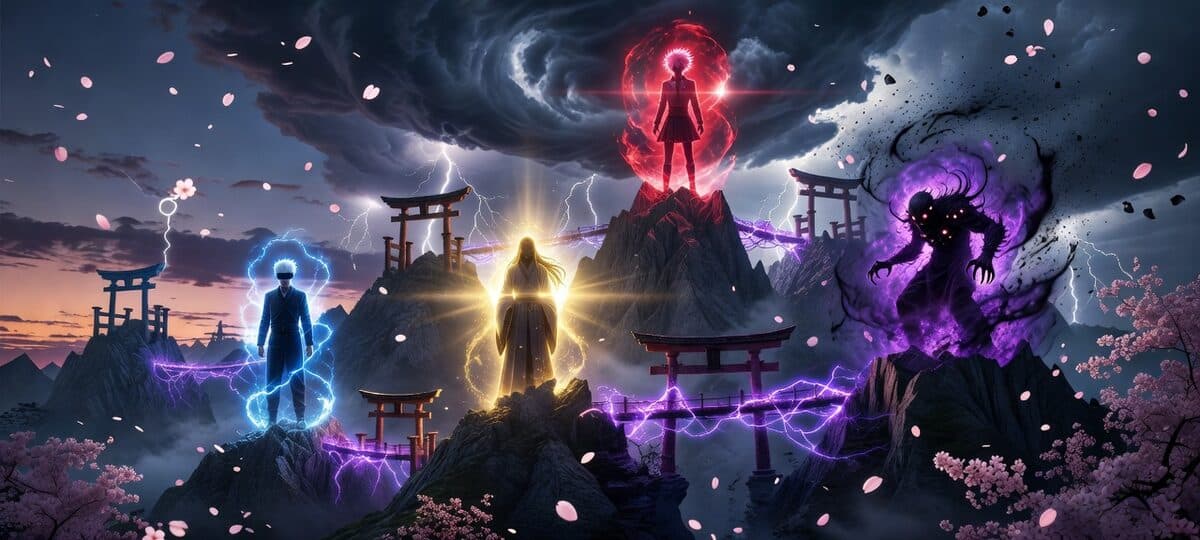
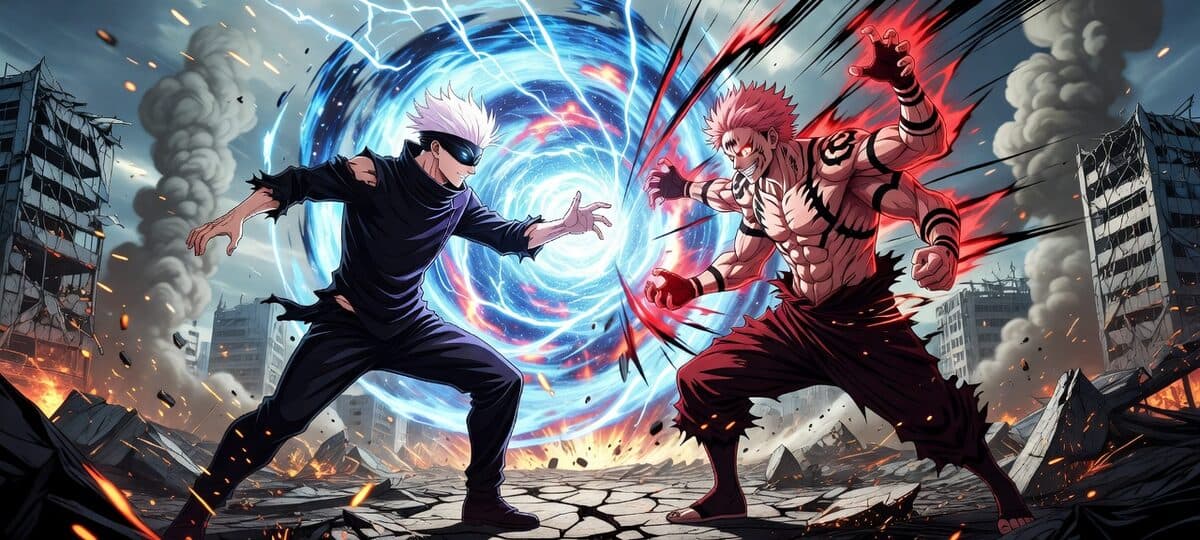
Sukuna is the strongest character in the completed original Jujutsu Kaisen manga, with Satoru Gojo second. The manga itself frames Sukuna as history's strongest sorcerer and Gojo as the strongest of the present era, then gives their fight a canon winner. The order below them is less explicit: this ranking places Yuta Okkotsu third, Kenjaku fourth, and Yuki Tsukumo fifth after weighing demonstrated peak power, repeatable win conditions, domains, survivability, and matchup breadth.
This is a full-manga spoiler ranking. It covers Gege Akutami's completed original series and treats Jujutsu Kaisen Modulo as a separate far-future comparison problem. Summons such as Mahoraga count as part of the technique user who controlled them; they are not ranked as independent people.
Strongest JJK characters at a glance
| Rank | Character | Peak evidence used | Team-help or matchup context | Confidence |
|---|---|---|---|---|
| First | Ryomen Sukuna | Defeated Gojo, survived the Shinjuku succession, and required a coordinated soul-separation finish | Ten Shadows and Mahoraga were part of his Gojo strategy | High |
| Second | Satoru Gojo | Pressured Sukuna across domain, recovery, and adaptation phases and destroyed Mahoraga | Lost the published duel after Sukuna learned the adapted targeting rule | High |
| Third | Yuta Okkotsu | Cleared the Sendai deadlock, used Copy and Rika across varied matchups, opened his domain against Sukuna | Kenjaku's death required Takaba's distraction; Shinjuku was a team operation | Medium |
| Fourth | Kenjaku | Defeated Yuki and Choso in Tengen's territory with an open-barrier domain and layered techniques | Lost to a planned distraction and Yuta's ambush rather than a clean duel | Medium |
| Fifth | Yuki Tsukumo | Special grade with Star Rage, Garuda, Reverse Cursed Technique, domain access, and a catastrophic final option | Fought beside Choso and used Tengen's plan; Kenjaku still survived | Medium |
| Sixth | Hajime Kashimo | Overwhelmed Panda, nearly killed jackpot Hakari, and spent his one-use technique against transformed Sukuna | His peak technique is fatal to himself and produced little sustained evidence | Medium |
| Seventh | Yuji Itadori | Awakened through black flash, learned healing and blood tools, gained Shrine and a domain, and attacked the soul boundary | His Sukuna finish depended on many allies and a favorable anti-incarnation effect | Medium |
| Eighth | Yorozu | Combined Construction, insect armor, domain pressure, and an extreme finishing technique | Her best full fight ended against Sukuna using Ten Shadows | Medium-low |
| Ninth | Maki Zen'in | Reached a Toji-like Heavenly Restriction state, ignored ordinary cursed-energy detection, and hurt Sukuna with a soul-cutting weapon | Her strongest Shinjuku openings came within a relay of attackers | Medium |
| Tenth | Kinji Hakari | Jackpot makes him extraordinarily hard to kill and let him outlast Kashimo's ordinary arsenal | His offense and consistency outside jackpot are less complete than the ranks above | Medium-low |
The first two placements rest on direct canon framing and a direct fight. The middle order is editorial because several candidates never fought each other under neutral conditions. A transparent ranking should make that uncertainty visible instead of hiding it behind a tier label.
How this JJK power ranking works
This ranking uses each character's strongest demonstrated original-manga state. Temporary techniques count, but their cost and repeatability count too. A fighter does not receive an ability because another character speculated they might learn it later.
Five questions govern the order:
- Can the character create a reliable finish? A spectacular attack matters less if its setup almost never survives contact with another top fighter.
- Can the character survive an enemy's best route? Domains, Reverse Cursed Technique, anti-domain tools, speed of tactical adjustment, and unusual bodies all matter.
- How broad is the toolkit? Copy, barriers, shikigami, cursed tools, soul interaction, and battlefield control can turn a bad raw-power comparison.
- Was the benchmark solo or assisted? Team victories still count as evidence, but the help is recorded rather than credited to one person.
- Was the advantage opponent-specific? Yuji's soul attacks are unusually valuable against an incarnated Sukuna. That does not automatically create the same edge against every natural-body sorcerer.
This method resembles our strongest anime characters framework, but the shared JJK power system allows more precise comparisons. For a franchise with another completed internal hierarchy, see the manga-evidence Hashira ranking.
First: Ryomen Sukuna
Sukuna owns the strongest overall record. He has exceptional cursed-energy reserves and control, an open-barrier domain, Reverse Cursed Technique, flexible binding-vow use, slashing attacks, fire, and the combat judgment to learn while under pressure. In Megumi's body, Ten Shadows added the adaptation route that decided his fight with Gojo.
The official VIZ setup calls him the strongest sorcerer in history, and the official volume 27 summary confirms that Gojo was defeated before Kashimo confronts Sukuna. Sukuna then survives a long relay of challengers. His eventual loss requires cumulative damage, Yuji's soul-targeting pressure, Nobara's remote strike, Megumi's resistance, and the broader group's sacrifices.
The case for first place does not require pretending every phase was easy. Gojo nearly ended the plan, and the later team steadily stripped Sukuna's output and control. Sukuna ranks first because he converted more difficult positions into wins and survived more distinct answers than anyone else.
Second: Satoru Gojo
Gojo's combination of Six Eyes and Limitless gives him the best passive defense in the original cast, extraordinary efficiency, precise Blue and Red control, Hollow Purple, Reverse Cursed Technique, and Unlimited Void. He can also change barrier conditions and restore a burnt-out technique while fighting at the highest pace shown in the series.
The gap between first and second is narrow. Gojo wins important domain exchanges, forces Sukuna to carry a long adaptation plan, destroys Agito and Mahoraga, and leaves Sukuna damaged. The canon result still places him below the opponent who found and executed the final answer.
Our full Gojo vs Sukuna fight explanation maps that causal chain. It also explains why the result answers the published matchup without proving every altered version or no-Mahoraga rematch.
Third: Yuta Okkotsu
Yuta gets the slight editorial edge over Kenjaku because his peak kit covers more kinds of opponent. His enormous cursed-energy supply, fully manifested Rika, Reverse Cursed Technique, sword skill, Copy, stored techniques, and domain give him answers at close range and at distance. The official Sendai volume summary records him disrupting a four-way deadlock involving reincarnated sorcerers and a special grade cursed spirit.
His later Shinjuku performance expands the ceiling. The official volume 28 summary records Yuta joining the Sukuna battle and opening his domain. His copied techniques and planning create meaningful openings even against the top-ranked fighter.
The main limitation is clean one-on-one proof. Yuta kills Kenjaku after Takaba creates the opening, and his Sukuna exchanges are part of a relay. Third place reflects toolkit breadth and peak options, not a claim that the story showed him defeating Kenjaku in a neutral duel.
Fourth: Kenjaku
Kenjaku may be the most technically complete barrier user below the top pair. Centuries of experience, Cursed Spirit Manipulation, gravity-related techniques, Reverse Cursed Technique, planning, and an open-barrier domain make him difficult to counter with a single specialty.
His best direct benchmark is the Star Corridor battle. Kenjaku survives pressure from Yuki and Choso, counters Tengen's barrier plan, and defeats Yuki. That win supports placing him above her. His position below Yuta is the closest call in this list because their encounter is resolved by strategy and surprise rather than a conventional duel.
Readers can reasonably swap third and fourth. Kenjaku has the stronger barrier résumé and more experience; Yuta has the more flexible combat inventory and a later peak. The ranking favors Yuta's breadth by a small margin and marks the confidence accordingly.
Fifth: Yuki Tsukumo
Yuki is one of the original series' special grade sorcerers and has a technique built to break ordinary durability assumptions. Star Rage adds virtual mass to her attacks and Garuda, giving her both brutal close-range force and a flexible cursed tool. She also demonstrates Reverse Cursed Technique and possesses a domain, even though the story does not show its full effect.
Her fight with Kenjaku proves both the ceiling and the problem. Yuki can damage and pressure a highly prepared top-tier opponent, but she follows Tengen's plan, fights with Choso, and still loses after Kenjaku adapts. Her final black-hole response is catastrophic, yet it is not a repeatable victory condition that lets her survive the outcome.
Fifth therefore reflects extreme peak threat with less repeatable evidence than Yuta or Kenjaku. It also avoids treating an ultimate self-sacrifice as an automatic win against every character.
Sixth: Hajime Kashimo
Kashimo enters the Culling Game with elite reinforcement, a dangerous electrical cursed-energy trait, sharp combat instincts, and an attack cycle that can create a lethal discharge without relying on a conventional domain. The official volume 21 summary establishes the scale gap when Panda is overwhelmed.
Against Hakari, Kashimo nearly solves an opponent whose jackpot continuously heals severe damage. He loses the result after Hakari exploits the environment and manages the round transitions, but the fight supports Kashimo's higher offensive placement.
Mythical Beast Amber raises Kashimo's peak and is used against Sukuna after Gojo's defeat. Its drawback is decisive for ranking: it is a one-use transformation that destroys Kashimo's body, and the transformed Sukuna ends the challenge quickly. Kashimo ranks above Yuji on peak solo offense, with lower sustainability and far less successful top-level duration.
Seventh: Yuji Itadori
Endgame Yuji combines extraordinary physical ability with Reverse Cursed Technique, Blood Manipulation learned through his unusual body and training, Shrine, repeated black flash success, Simple Domain, soul awareness, and his own Domain Expansion. He grows during the final battle rather than arriving with one fixed kit.
The official volume 29 summary states that Yuji uses black flash to awaken his potential while closing in with help. The official final-volume summary identifies his key finishing job: attack the seam between Sukuna's soul and Megumi's to separate them.
That soul interaction is both a strength and a ranking caution. It makes Yuji unusually effective against Sukuna's incarnation state, but the final result belongs to a coordinated operation. Yuji deserves the highest placement among the surviving younger frontline fighters; the manga does not establish him above Sukuna or Gojo.
Eighth: Yorozu
Yorozu's Construction technique is inefficient in theory but formidable in her hands. Insect armor improves close combat, liquid metal creates adaptable pressure, and her domain can turn the Perfect Sphere concept into a terrifying finish.
Her evidence is concentrated in one major fight against Sukuna. She pushes him to reveal the range of Ten Shadows tools he wants to test, but Sukuna deliberately avoids relying on his own innate technique and wins through the borrowed system. That makes Yorozu clearly dangerous without supplying the broad résumé held by the characters above her.
Yorozu and Yuji can swap depending on whether a reader values a cleaner theoretical finisher or endgame adaptability. This list favors Yuji's wider demonstrated toolkit and sustained performance across the final operation.
Ninth: Maki Zen'in
Maki's completed Heavenly Restriction removes cursed energy while giving her exceptional physical ability and senses. That changes how barriers and ordinary cursed-energy tracking interact with her. With the Split Soul Katana, she can bypass conventional toughness when she correctly perceives the target's soul.
The official Sakurajima volume summary records the rapidly evolving curse that initially threatens Maki and Noritoshi. Her breakthrough during that battle brings her to the comparison point established by Toji and turns her into one of the final raid's most dangerous surprise attackers.
She ranks below Yuji because he develops more recovery and technique options, and below Yorozu because a completed domain remains a severe matchup problem. Maki's anti-detection properties can reverse either fight under the right conditions, which is why her placement carries meaningful matchup uncertainty.
Tenth: Kinji Hakari
Hakari's domain and jackpot make him one of the hardest fighters to put down. During jackpot, overflowing cursed energy drives automatic Reverse Cursed Technique at a level that lets him recover from damage that would end most battles. His willingness to gamble, reposition, and exploit an opponent's goal is part of the technique's strength.
The Kashimo fight earns Hakari this place. He survives a much sharper lethal arsenal, manipulates the battlefield, and reaches a winning result without simply overpowering every exchange. He later occupies Uraume through the Sukuna operation, protecting the main team from another top threat.
The limitation is consistency. Hakari's best state depends on his domain cycle, and his demonstrated finishing power is less decisive than Kashimo's, Yuji's, or Maki's. He reaches the list because his survival loop can deny stronger-looking opponents a clean win.
Close calls and exclusions
Toji Fushiguro is the hardest exclusion. His Heavenly Restriction, senses, cursed-tool mastery, preparation, and anti-sorcerer instincts make him comparable to awakened Maki. The list uses Maki because the completed manga gives her the later Sukuna benchmark; treating them as close equivalents is more defensible than claiming a large gap.
Uraume also has a strong case through large-area ice control, Reverse Cursed Technique, and the ability to occupy Hakari. The manga provides less of the fight's interior than it does for Hakari's earlier showcase, so Uraume remains just outside the ordered group.
Takaba may have the strangest ceiling. Comedian can alter events according to what he finds funny, and his confrontation creates the opening that ends Kenjaku. Its psychology-dependent activation and Takaba's unusual relationship to lethal intent make it difficult to rank as a repeatable duel kit.
Other close candidates include Toji, Uraume, Mahito, Jogo, Ryu Ishigori, and Takaba. A larger list can name more characters, but it often creates false precision below the evidence-rich group.
For another franchise-specific hierarchy built around peak state and fight context, see the strongest One Piece characters ranking. Our top anime power-ups guide handles transformations separately so temporary forms do not silently become a character's normal baseline.
Does Jujutsu Kaisen Modulo change this ranking?
It creates a separate ranking question. The official Weekly Shonen Jump page for Jujutsu Kaisen Modulo places it 68 years after the Culling Game in 2086 and centers a later cast. VIZ's official Modulo chapter index records the completed English publication run.
This page does not merge those far-future characters into the original-series ladder. The sequel changes the era, cast, conflicts, and available comparison points. A combined list would need its own rules for aging original characters, new species, inherited techniques, and whether a brief appearance supplies enough evidence for a placement.
That boundary also corrects the previous article's central failure. A real sequel title does not validate an ability unless the published chapters demonstrate it. This ranking will not assign Yuji new techniques or declare that he overtook the original top pair through extrapolation.
For more evidence-led lists, visit the anime rankings hub.
Sources and update policy
The scope and sequence are checked against the official VIZ chapter index, the official volume summaries linked beside major benchmarks, and Weekly Shonen Jump's Modulo record. The original series ends at chapter 271; the ranking uses that completed record rather than anime-only progress.
Placements below Sukuna and Gojo remain editorial. If an official guide or sequel source creates a direct shared benchmark, the affected row and confidence label should be revised instead of silently rewriting the criteria.
After reading the full ranking, readers looking for the source can browse current listings for the Jujutsu Kaisen manga or the official character guide. As an Amazon Associate, PrimeTime Anime earns from qualifying purchases; the price is unchanged for you.
Frequently Asked Questions
Who is the strongest character in Jujutsu Kaisen?
Sukuna is the strongest in the completed original manga. The official story frames him as history's strongest sorcerer, and he wins the direct fight against Gojo before surviving the later team relay.
Is Gojo stronger than Sukuna?
Gojo is close enough to create several winning positions, but the canon fight ends with Sukuna's victory. Alternate rules can still be debated; they do not replace the published result.
Is Yuta stronger than Kenjaku?
This ranking gives Yuta a narrow edge because of his peak toolkit and flexibility. Kenjaku has the better barrier résumé, and their actual encounter uses Takaba's distraction and an ambush, so a neutral duel remains unresolved.
Where does Yuji rank after the manga ending?
Yuji ranks seventh here. His healing, Blood Manipulation, Shrine, domain, black flash awakening, and soul-targeting attacks make him elite, but the Sukuna victory required extensive team support and a matchup-specific separation plan.
Why is Mahoraga not ranked separately?
Mahoraga is a shikigami summoned through Ten Shadows, so this list treats it as part of the controlling technique user's available toolkit. Ranking summons separately would mix people with abilities and double-count Sukuna's demonstrated route.
Are Modulo characters included?
No. Jujutsu Kaisen Modulo takes place 68 years later and gets a separate scope. This ranking covers the completed original manga so every placement shares the same narrative era and evidence rules.

Written by WeebRai
Founder · Editor · Chief OtakuOne fan, 12+ years deep, 1,200+ series in. Every review, recap and ranking on PrimeTime Anime is written by WeebRai — checked against the actual episodes and manga, never recycled from press releases.
Share this article
Keep Reading
Test your fandom
Which Naruto Clan Do You Belong In?
Discover your Naruto clan by answering these personality questions.
Take the quiz →
Hunter x Hunter Nen Mastery Examination
Test your knowledge of Hunter x Hunter with these trivia questions about key characters and concepts.
Take the quiz →
Attack on Titan Ultimate Trivia Challenge
Test your knowledge with these hard trivia questions from Attack on Titan.
Take the quiz →