
Gojo vs Sukuna: Who Won and How the Fight Ended
A spoiler-heavy, canon-first explanation of who won Gojo versus Sukuna, how Mahoraga changed the fight, and what the result does not prove.
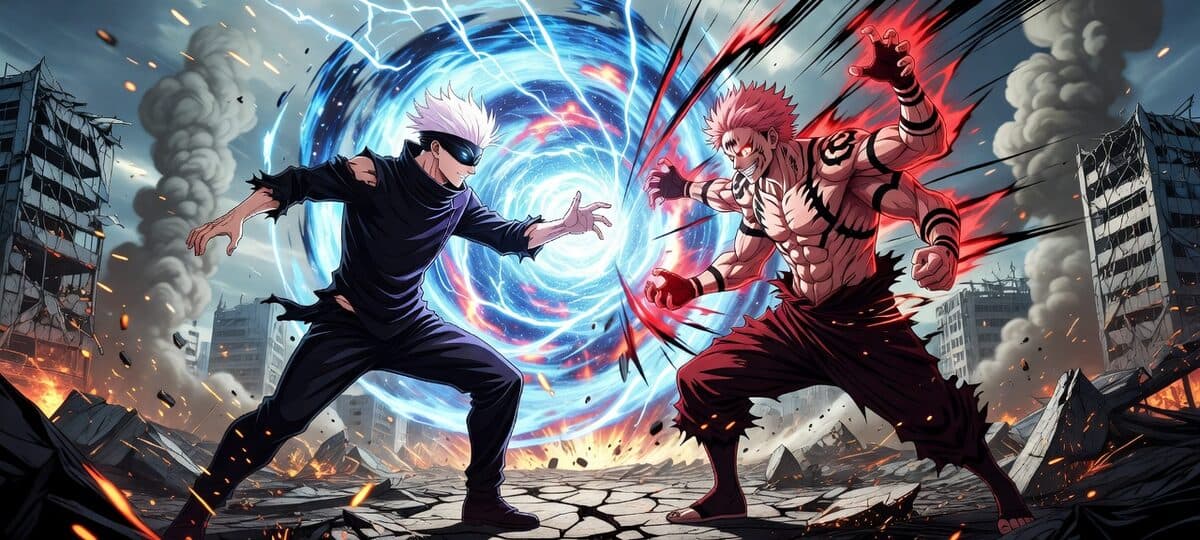
Sukuna won the canon Gojo vs Sukuna fight. Gojo controlled several stretches of the battle and appeared to have broken Sukuna's plan near the end, but Sukuna used Mahoraga's adaptation as a model for an attack that targeted the space Gojo occupied. Infinity could slow attacks approaching Gojo; it could not protect him when the target of the slash was expanded beyond Gojo himself. The published result is Sukuna's victory and Gojo's defeat.
That answer covers the fight Gege Akutami wrote, with Sukuna fighting in Megumi Fushiguro's body and using the Ten Shadows Technique. A different question—whether another version of Sukuna beats Gojo without Mahoraga—remains a counterfactual. Canon gives readers evidence for that debate, but it does not rerun the match under changed rules.
Manga spoiler warning: This analysis covers the full battle and its outcome in Jujutsu Kaisen chapters 221–236.
Gojo vs Sukuna result at a glance
| Question | Answer | Evidence status |
|---|---|---|
| Who won Gojo vs Sukuna? | Sukuna | Explicit canon result |
| Was the fight competitive? | Yes; both fighters forced repeated tactical changes and suffered major damage | Demonstrated in the published fight |
| What decided it? | Sukuna converted Mahoraga's successful adaptation into a slash whose target included the space Gojo occupied | Sukuna's explanation after the decisive attack |
| Did Infinity stop working? | Infinity still worked according to its normal approach-based rule; Sukuna changed what his attack targeted | Mechanism explained in canon |
| Did Gojo have winning moments? | Yes; he damaged Sukuna, won important exchanges, and destroyed Mahoraga | Demonstrated, but not the final result |
| Does this prove every version of Sukuna always wins? | No | Counterfactual versions were not fought |
| Does the fight establish exact speed or destructive tiers? | No | Those labels come from fan models, not official measurements |
VIZ's official page for the next volume removes any ambiguity from the result: its summary opens by stating that Gojo has been defeated. The interesting question is therefore how Sukuna reached that result after Gojo seemed to seize the finish.
Which versions of Gojo and Sukuna fought?
Gojo entered as the restored Satoru Gojo, using Limitless, Six Eyes, Reverse Cursed Technique, Unlimited Void, Blue, Red, and Hollow Purple. He was the strongest sorcerer of the present era and fought with the confidence and improvisation that title implies.
Sukuna entered while incarnated in Megumi's body. That matters because his toolkit included his own slashing technique and Malevolent Shrine alongside Megumi's Ten Shadows Technique. Mahoraga was not an outside spectator added to a neutral duel. Sukuna acquired and used that technique inside the story before this battle.
The official VIZ volume setup describes Sukuna as history's strongest sorcerer and Gojo as the present day's strongest before announcing their clash. That framing supports a contest between two apex fighters. It does not turn their titles into numerical stats, and it does not erase the specific bodies, techniques, preparation, and decisions present in the match.
This distinction also prevents a common search-intent error. “Who won?” asks for the published result. “Who is stronger under different conditions?” asks for an editorial simulation. The first has a canon answer. The second changes as soon as a reader removes Ten Shadows, changes Sukuna's body, restricts domains, or supplies either fighter with advance knowledge.
How the Gojo vs Sukuna fight unfolded
The fight runs from the return and setup in chapter 221 through the result in chapter 236. The official VIZ chapter index is the stable English publication record for that span. The table below compresses the battle into causal phases rather than cataloguing every blow.
| Phase | What Gojo accomplished | What Sukuna accomplished | Why it mattered |
|---|---|---|---|
| Opening pressure | Forced Sukuna to defend immediately and established his ranged threat | Survived the surprise opening and closed into the real contest | Neither title made the other fighter helpless |
| Domain exchanges | Altered Unlimited Void's barrier conditions, recovered his technique, and damaged Sukuna during close combat | Used Malevolent Shrine's open range to attack the outside of Gojo's barrier and repeatedly changed his own conditions | Each fighter answered a rule of the other's domain instead of relying on raw output alone |
| Domain breakdown | Landed a brief Unlimited Void advantage and pushed Sukuna to the edge of maintaining his domain | Kept Mahoraga's adaptation route active and called it when Unlimited Void connected | Mahoraga prevented the domain advantage from becoming Gojo's finish |
| Adaptation race | Used movement, Blue, Red, and close combat to pressure Sukuna while searching for a decisive attack | Protected and studied Mahoraga's adaptation while attacking alongside his shikigami | Sukuna needed a usable answer to Infinity, while Gojo needed to end the process before that answer matured |
| Hollow Purple reversal | Destroyed Mahoraga and left Sukuna visibly damaged | Preserved the technical model Mahoraga had already demonstrated | Gojo removed the adapting shikigami, but the learned solution did not disappear with it |
| Final attack | Had no shown answer before the decisive cut landed | Applied the adapted targeting concept through his own slashing technique | The target was the space containing Gojo, bypassing Infinity's normal approach filter |
The official VIZ summary for volume 26 highlights the same structural center: the fighters repeatedly open domains, repair burnt-out cursed techniques, and reach the point where Sukuna summons Mahoraga. Those are not side details. They form the chain that produces the ending.
Why the domain battle did not settle it
Unlimited Void and Malevolent Shrine operate differently. Gojo normally encloses a target inside his barrier. Sukuna's domain manifests without the same closed outer shell, allowing its effect to extend into the surrounding space. Early in the domain contest, that difference lets Sukuna attack a vulnerable side of Gojo's barrier.
Gojo does not simply repeat a failed move. He changes the barrier's conditions, uses Reverse Cursed Technique in unusually aggressive ways, and fights Sukuna inside the domains. Sukuna also changes range and conditions, uses Domain Amplification when needed, and manages the tension between direct defense and the longer adaptation plan.
The crucial swing arrives when Unlimited Void catches Sukuna long enough to threaten an ending. Mahoraga intervenes and breaks the domain. Soon after, the accumulated strain prevents both men from treating another domain as an easy reset. The battle shifts from “whose sure-hit wins?” to “can Gojo finish before adaptation supplies a complete answer to Infinity?”
This is why a simple claim that one domain is universally stronger misses the actual fight. Gojo found answers to Malevolent Shrine's barrier advantage. Sukuna found a way to keep the adaptation route alive through Gojo's domain pressure. The domain phase damaged both fighters and narrowed their options; it did not independently declare the winner.
How Mahoraga helped Sukuna bypass Infinity
Infinity is best understood as an approach problem. An ordinary attack moving toward Gojo encounters the spatial effect of Limitless and fails to reach him in the expected way. Sukuna therefore needed more than a stronger projectile or a faster swing. He needed a method that did not ask an ordinary attack to cross the protected interval.
Mahoraga adapts after exposure to a phenomenon, and its wheel signals the process. Sukuna used that property as research conducted under combat pressure. The first useful adaptation gave Mahoraga a way to engage Gojo, but Sukuna continued waiting for an adaptation he could reproduce with his own technique.
The decisive model changed the target. Instead of treating Gojo as an object behind Infinity, the attack cut the space in which Gojo existed. Fans often call the resulting application a world-cutting slash. The useful part of that label is the targeting rule: Sukuna's slash did not beat Infinity by traveling through it in the ordinary way.
The causal chain is compact:
- Infinity prevented Sukuna's normal approach-based attacks from reaching Gojo cleanly.
- Mahoraga remained exposed long enough to develop a different answer.
- Sukuna observed an adaptation compatible with his own slashing technique.
- Gojo destroyed Mahoraga, but the demonstrated model had already been learned.
- Sukuna expanded the target of his next decisive slash to the space Gojo occupied.
That sequence gives Mahoraga a precise role. It was the model and bridge to the solution. Saying only “Sukuna was stronger” hides the mechanism; saying Mahoraga alone won ignores Sukuna's planning, survival, observation, and ability to reproduce the adapted idea.
Did Gojo nearly win?
Yes. Gojo created several legitimate finishing opportunities. He recovered from Malevolent Shrine, injured Sukuna badly enough to disrupt the domain contest, pressed the adapting formation in close combat, eliminated Agito, and used Hollow Purple to destroy Mahoraga while damaging Sukuna.
The presentation immediately before the result is designed to make Gojo's position look favorable. That makes the reversal abrupt, but it does not make the earlier exchanges fake. Gojo's successes forced Sukuna to depend on a narrow, technically demanding route. Sukuna's success means that route worked before Gojo could complete the finish.
“Nearly won” and “won” are different claims. The first describes the state readers and observers inferred near the end. The second is determined by who survived the duel and continued into the next battle. The official volume sequence moves from the Gojo battle to Kashimo confronting Sukuna, confirming continuity after Gojo's defeat.
Readers who enjoy bounded matchup reasoning can compare this treatment with our Naruto vs Luffy rules-based analysis. That cross-series question requires declared assumptions because no canon fight exists. Gojo versus Sukuna requires fewer invented rules because the manga supplies the matchup and its result.
Did Sukuna need Mahoraga to beat Gojo?
Sukuna used Mahoraga to win the fight that was actually published. More specifically, he used Mahoraga's adaptation to obtain a model for bypassing Infinity with his own slash. Removing that route changes a central part of his demonstrated plan.
That does not prove Sukuna would lose every alternate match. A different body or technique restriction changes domain tactics, close combat, defensive choices, and the amount of risk each fighter accepts. It also does not prove Sukuna would reproduce the same ending without the model. Canon shows one successful strategy, not every possible branch.
The most defensible counterfactual answer is therefore limited:
| Alternate question | What canon supports | What remains unresolved |
|---|---|---|
| Sukuna without Ten Shadows | He still has exceptional domain skill, cursed-energy control, slashing attacks, and combat judgment | Whether those tools produce a finish before Gojo does |
| Gojo with full knowledge of the adapted slash | He is highly adaptive and can change tactics under pressure | Whether awareness provides a reliable defense against that targeting rule |
| Sukuna in another body | His physical options and technique mix change | How the entire domain and adaptation sequence would unfold |
| A rematch with no preparation | Both can improvise at an extreme level | Which risks and conditions either fighter would choose differently |
Use the strongest JJK characters ranking for the completed original manga's wider ladder, the strongest anime characters ranking for a cross-series framework, and the strongest Hashira ranking for another completed-story comparison. None of those formats overrides a direct canon result.
What the result proves—and what it does not
The result proves that Sukuna defeated Gojo under the exact conditions of the Shinjuku fight. It proves that Infinity had a workable counter once Mahoraga supplied a reproducible targeting model. It also proves that Gojo could threaten Sukuna across domains, hand-to-hand exchanges, technique recovery, and high-output attacks.
It does not produce an official speed number, a universal destructive tier, or a percentage for hypothetical rematches. It does not mean every slash ignores Infinity. It does not turn Mahoraga into an automatic answer before adaptation occurs. It does not establish that Gojo's earlier advantages were meaningless.
This evidence boundary is useful beyond one battle. Our top anime power-ups analysis separates released demonstrations from hype, while the Attack on Titan ending explanation separates explicit canon from thematic interpretation. The same discipline makes a fight answer easier for readers and answer engines to quote without stripping away a crucial condition.
For more comparisons and evidence-led lists, browse the anime rankings hub.
Sources and update policy
The result and phase boundaries are checked against VIZ's official English chapter and volume records. The Japanese Weekly Shonen Jump series directory provides a second official publication trail, and the anime character directory confirms the official character naming used here. Tactical descriptions are concise paraphrases of the published manga rather than fan calculations.
This page will be updated if an official translation, collected edition, or anime adaptation adds material that changes the explanation. Adaptation choices may clarify presentation, but they do not silently replace the manga outcome.
If you want the source material after reading the full answer, the fight is collected across the surrounding volumes. You can check current listings for Jujutsu Kaisen volume 26 and Jujutsu Kaisen volume 27. As an Amazon Associate, PrimeTime Anime earns from qualifying purchases; the price is unchanged for you.
For contrast with a matchup whose result is not canonically published, the Goku vs Saitama comparison shows how explicit versions, fight rules, and uncertainty replace a fake definitive crossover result.
Frequently Asked Questions
Who won Gojo vs Sukuna in the manga?
Sukuna won. The official VIZ summary for the following volume states that Gojo was defeated, and the story continues with Kashimo confronting Sukuna.
How did Sukuna get through Infinity?
Mahoraga adapted to Gojo's technique and eventually demonstrated a targeting solution Sukuna could reproduce. Sukuna applied his slash to the space Gojo occupied, so the attack did not need to approach Gojo through Infinity in the ordinary way.
Did Mahoraga kill Gojo?
No. Mahoraga supplied the adaptation model, but Sukuna performed the decisive slash. Mahoraga was essential to the strategy used; Sukuna executed and won with that strategy.
Did Gojo destroy Mahoraga?
Yes. Gojo's Hollow Purple destroyed Mahoraga near the end of the fight. The problem was timing: Mahoraga had already demonstrated the adaptation Sukuna needed to imitate.
Would Sukuna win without Ten Shadows?
The manga does not run that alternate fight, so it has no canon result. Sukuna retains formidable tools without Ten Shadows, but readers cannot remove the adaptation route and still claim the published ending proves the same outcome.
Is the Gojo vs Sukuna fight animated?
The manga is the source used for this complete result. Check the official anime site for adaptation announcements and episode information rather than treating fan animations as released canon.

Written by WeebRai
Founder · Editor · Chief OtakuOne fan, 12+ years deep, 1,200+ series in. Every review, recap and ranking on PrimeTime Anime is written by WeebRai — checked against the actual episodes and manga, never recycled from press releases.
Share this article
Keep Reading
Test your fandom
Which Naruto Clan Do You Belong In?
Discover your Naruto clan by answering these personality questions.
Take the quiz →
Hunter x Hunter Nen Mastery Examination
Test your knowledge of Hunter x Hunter with these trivia questions about key characters and concepts.
Take the quiz →
Attack on Titan Ultimate Trivia Challenge
Test your knowledge with these hard trivia questions from Attack on Titan.
Take the quiz →